
Site added
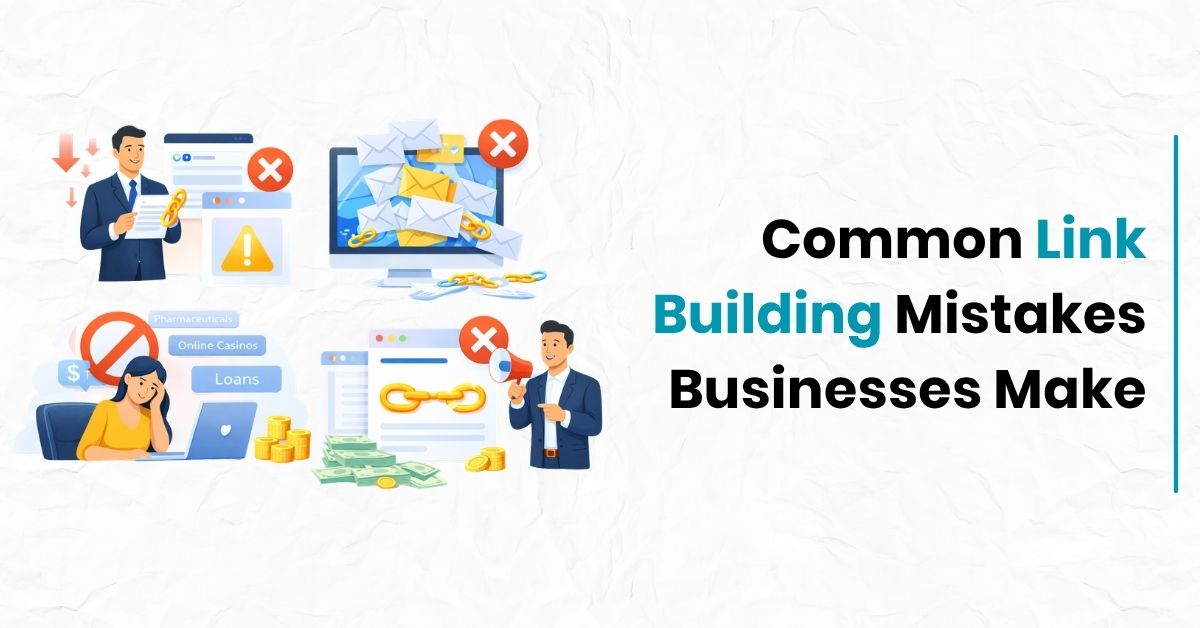
A lot of businesses don’t lose rankings because they ignore SEO. They lose them because they build the wrong links, from the wrong places, for the wrong reasons. We’ve seen brands spend months chasing volume, only to end up with weak referring domains, messy anchor text, and backlinks that look active in a report but do almost nothing in the SERP.
Link building services help businesses earn relevant, trustworthy backlinks that improve authority and visibility. But the value comes from quality, placement, context, and intent, not raw link count. When businesses treat link building like a numbers game, they usually waste budget, slow down results, and create cleanup work they could have avoided in the first place.
Why do businesses keep making the same link building mistakes?
Because link building looks simple from the outside. Get a backlink. Repeat. Move up.
But that’s not how it works in real campaigns. Google looks at topical relevance, editorial quality, anchor usage, site trust, placement, and how natural the full backlink profile looks over time. One decent link from a relevant page can do more than 50 random links from pages nobody reads.
Chasing quantity over relevance
This is still the most common mistake we see.
A business wants faster SEO growth, so it buys bulk placements without checking if those sites actually match the niche, the page topic, or the audience. The result is a backlink profile that looks inflated on paper but weak in practice. The domains might have metrics. The links still don’t move the needle.
Relevance matters because backlinks are not just signals of existence. They’re signals of trust and association. If a B2B SaaS brand gets links from unrelated coupon blogs, low-value directories, and spun guest post sites, the pattern looks off. And users don’t trust it either.
Treating every domain authority metric like truth
DA, DR, traffic estimates, and referring domain counts can be useful. We use them too. But they are filters, not final decisions.
A high-metric website with no real audience, weak editorial standards, and thin content is not automatically a strong placement. We’ve had clients come to us after buying expensive links on “authority” sites that had almost no topical fit and zero meaningful referral traffic. Nice spreadsheet. Poor SEO outcome.
So yes, metrics matter. But context matters more. We’d rather place a link on a relevant industry publication with steady organic visibility than force one onto a flashy site that only looks good in a sales deck.
Ignoring anchor text balance
Anchor text gets mishandled all the time. Some businesses over-optimize with exact-match phrases on every campaign. Others go so vague that nothing sends a clear relevance signal.
The best backlink profiles have variety. Brand anchors, partial match anchors, natural phrases, naked URLs, and contextual internal support all play a role. When every link points to the same page with the same keyword-heavy text, it stops looking organic. Fast.
A few months back, we were helping a service brand that had built dozens of links with nearly identical commercial anchors. Rankings stalled. And some pages became more volatile than they should have been. Once we cleaned up the anchor strategy and shifted to a more natural mix, the profile started to look healthier and performance improved over the next few months.
What happens when businesses use the wrong sources?
They end up paying for links that create risk instead of value.
That usually happens when people rely on public seller lists, recycled outreach databases, or low-quality placement networks with little editorial control. A weak link building Marketplace can make this worse by prioritizing availability over quality. And when every site sells every topic to everyone, the footprint becomes obvious.
Common signs of bad sources
Low-quality sources usually share a few patterns:
- Thin content with no clear audience
- Overloaded outbound links on every article
- Irrelevant categories mixed together
- Traffic drops that suggest declining visibility
- No editorial review, just instant publishing
That’s why vetting matters. A proper campaign should look at niche fit, content quality, indexing, organic trends, page quality, and whether the placement feels editorial rather than transactional.
Confusing placement with strategy
Getting a backlink is not the same as having a link strategy.
A real strategy connects target pages, search intent, anchor text, content angles, outreach targets, and business goals. Some pages need authority links. Some need supporting internal links. Some need digital PR or media pickup. Others need guest posting on niche sites that already rank for related queries.
We’ve seen businesses buy links to the homepage month after month and then wonder why their service pages don’t improve. That’s a planning problem, not a budget problem.
How do I build backlinks without hurting my SEO?
Start by thinking like a marketer, not just a buyer of placements. The best way to build links without creating risk is to focus on relevance, editorial standards, and long-term profile health.
And keep the process boring in the best way. Steady. Thoughtful. Defensible. That’s how sustainable SEO usually looks.
Relying only on one tactic
Some brands use only guest posts. Others chase only HARO-style mentions, directory links, or homepage links. That narrow approach limits growth.
A strong campaign usually mixes tactics based on the brand and the page. At Vefogix, we often see better results when businesses combine a backlink building service with selective guest posting service support, press release service visibility for brand mentions, and content-led outreach that earns placements naturally. Not all at once. But in the right mix.
That balance helps build a backlink profile that looks more natural and supports different types of pages across the site.
How to avoid common link building mistakes
If we were setting up a campaign from scratch, here’s the checklist we’d follow:
Audit the current backlink profile before building anything new
Choose target pages based on ranking opportunity and conversion value
Prioritize relevant websites over inflated authority metrics
Use a natural anchor text mix across brand, partial match, and generic anchors
Review site quality manually instead of relying only on tools
Mix tactics like guest posting, editorial outreach, and brand mentions
Track results by rankings, traffic, indexing, and assisted conversions
That process isn’t flashy. But it saves money and protects the campaign from avoidable mistakes.
Are businesses underestimating content quality in link building?
Yes. All the time.
Weak content can ruin a decent placement. If the article is generic, stuffed with anchors, or clearly written just to host a link, the value drops. Editors notice it. Readers notice it. Search engines probably do too. Good link building needs good content around the link, not just the link itself.
This is one reason many SEO teams now care more about editorial fit than raw scale. According to industry studies often cited in SEO circles, backlinks remain one of Google’s strongest ranking signals, but not all links pass equal value. We’ve seen that firsthand across campaigns in local SEO, SaaS SEO, and national service businesses.