
Site added
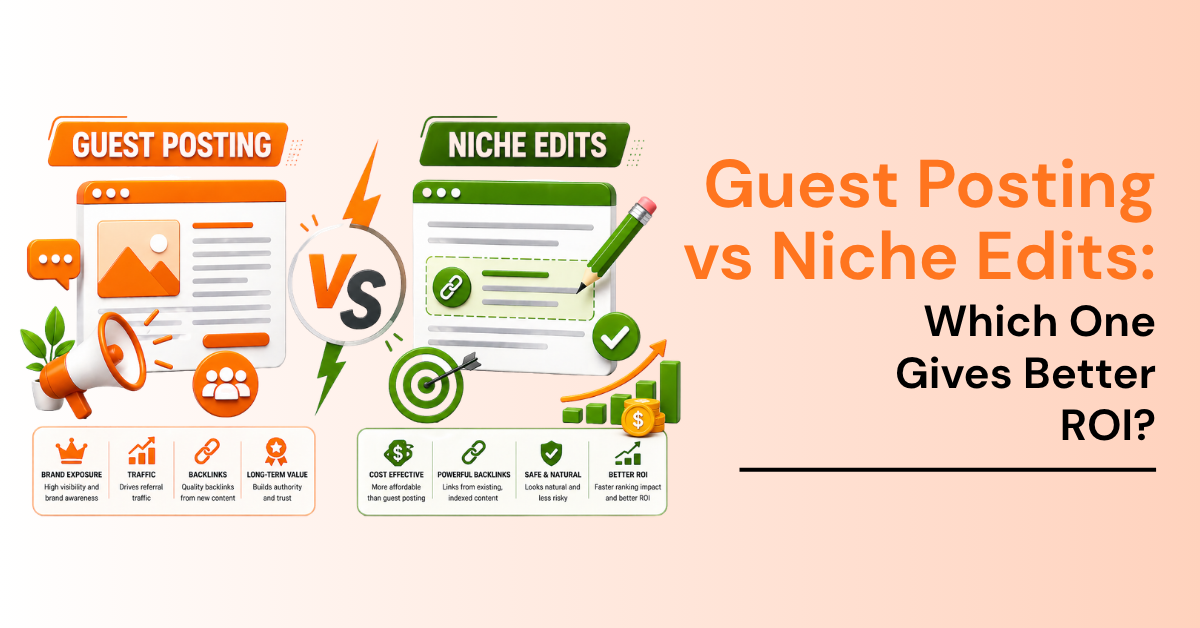
If you've spent any time building backlinks, you've probably wrestled with the same question every SEO professional eventually faces: should you invest in guest posting or niche edits? Both strategies can move the needle on your rankings, but they work in fundamentally different ways and the return you get depends heavily on how, when, and why you use each one.
Let's break down the mechanics, costs, and real-world performance of both so you can make a smarter decision with your link-building budget.
Understanding the Two Strategies
Guest posting involves writing a fresh piece of content and publishing it on another website within your industry. The article typically includes one or two contextual backlinks pointing to your site. You're essentially trading valuable content for link placement and brand exposure.
Niche edits (sometimes called link insertions or curated links) take a different approach entirely. Instead of creating new content, you secure a backlink by having it added to an existing, already-indexed article on another website. The page has history, existing authority, and in many cases organic traffic already flowing to it.
Both methods aim for the same outcome: contextual, relevant backlinks that signal trust and authority to search engines. But the path to that outcome shapes everything from cost to timeline to long-term value.
Cost Comparison
Guest posting tends to carry a higher upfront investment. You're paying for content creation (either writing it yourself or hiring a writer), outreach to find placement opportunities, and often a publishing fee charged by the host site. A single quality guest post on a reputable site can run anywhere from $100 to $500 or more, depending on the domain's authority and traffic.
Niche edits usually come in at a lower price point. Since there's no new content to produce, the primary cost is the outreach and the placement itself. Expect to pay between $50 and $300 per link on average, though premium placements on high-authority pages can cost significantly more.
On the surface, niche edits look like the budget-friendly option. But cost per link is only part of the equation.
Speed of Results
This is where niche edits hold a clear advantage. When your link is placed on a page that's already indexed, already ranking, and already earning organic traffic, you can see movement in your rankings considerably faster. Search engines don't need to discover and evaluate a brand-new page the authority is already established.
Guest posts, on the other hand, take time to get indexed and accumulate their own authority. A freshly published guest article might sit idle for weeks or even months before it starts passing meaningful link equity. If the host site has strong domain authority and regularly publishes content, this timeline shortens but it's rarely as fast as a well-placed niche edit.
Link Quality and Relevance
Quality hinges less on the method and more on the execution. A guest post on a high-authority, topically relevant site with genuine readership will outperform a niche edit shoehorned into an irrelevant article every time and vice versa.
That said, each strategy has natural strengths when it comes to quality:
Guest posts give you full control over the surrounding content. You choose the topic, craft the narrative, and place your links within context you've specifically designed. This level of control makes it easier to ensure topical relevance and anchor text diversity.
Niche edits leverage existing content that has already proven its value. A link placed in an article that ranks on page one for competitive keywords carries weight that a brand-new article simply can't match right away. The challenge is finding placements where your link fits naturally forced insertions into unrelated content can do more harm than good.
Risk Profile
Every link-building strategy carries some degree of risk, and it's worth understanding the differences here.
Guest posting at scale can create footprint issues. If search engines detect a pattern of identical author bios, similar content structures, or links from a network of loosely related sites, the value of those links diminishes. In extreme cases, it can trigger manual penalties. The key to mitigating this risk is diversity in the sites you target, the content you produce, and the anchors you use.
Niche edits carry their own risks. If a webmaster inserts your link in a way that disrupts the natural flow of the article, or if the page accumulates too many outbound links over time, it can look manipulative. There's also the risk that the page owner removes your link later, especially if there's no ongoing relationship or contractual agreement in place.
Ancillary Benefits Beyond Links
ROI isn't just about link equity. Guest posting offers several secondary benefits that niche edits simply can't match.
When you publish a well-written guest post, you're putting your name, your brand, and your expertise in front of a new audience. This builds thought leadership, drove referral traffic, and opens doors to future partnerships and collaborations. Over time, a portfolio of quality guest posts establishes you as an authority in your space benefit that compounds well beyond the initial link.
Niche edits are more transactional by nature. You get the link, and ideally some referral traffic from the existing page, but there's no brand-building component. No byline, no author bio, no opportunity to showcase your expertise to a new audience.
If your goals extend beyond rankings if you're building a brand, establishing credibility, or trying to attract partnerships guest posting delivers value that doesn't show up in a simple ROI calculation.
Scalability
Niche edits are generally easier to scale. The turnaround is faster since there's no content production bottleneck, and the outreach process can be more streamlined. If you need to build a high volume of links in a short timeframe, niche edits offer a more efficient path.
Guest posting at scale requires significant content production capacity. Every placement needs a unique, quality article and cutting corners on content quality is one of the fastest ways to tank a guest posting campaign. Scaling successfully means either building an in-house writing team or partnering with reliable content providers, both of which add cost and complexity.
So, Which One Gives Better ROI?
The honest answer: it depends on your situation, and the smartest operators use both.
Choose guest posting when you're building a brand from the ground up, entering a new market, or targeting highly competitive keywords where topical authority and content relevance matter most. The higher upfront cost pays dividends through brand exposure, relationship building, and long-term authority.
Choose niche edits when you need faster results, you're working with a tighter budget, or you've already established your brand presence and simply need to strengthen your backlink profile. The efficiency and speed of niche edits make them ideal for targeted ranking pushes.
The strongest approach combines both strategies. Use guest posting to build foundational authority and brand presence on key publications in your space. Supplement with niche edits to accelerate specific ranking targets and fill gaps in your link profile. This balanced approach diversifies your backlink profile which is itself a ranking signal while maximizing both short-term gains and long-term growth.
Final Takeaway
There's no universally "better" option between guest posting and niche edits. The strategy that delivers the best ROI is the one that aligns with your specific goals, timeline, and budget. What matters most isn't the method it’s the quality of the sites you target, the relevance of the placements you secure, and the consistency with which you execute.
Stop thinking of it as an either-or decision. Start thinking of it as a portfolio and allocate your resources where they'll generate the highest return for where your business stands today.