
Site added
Introduction: What Is Adsy?
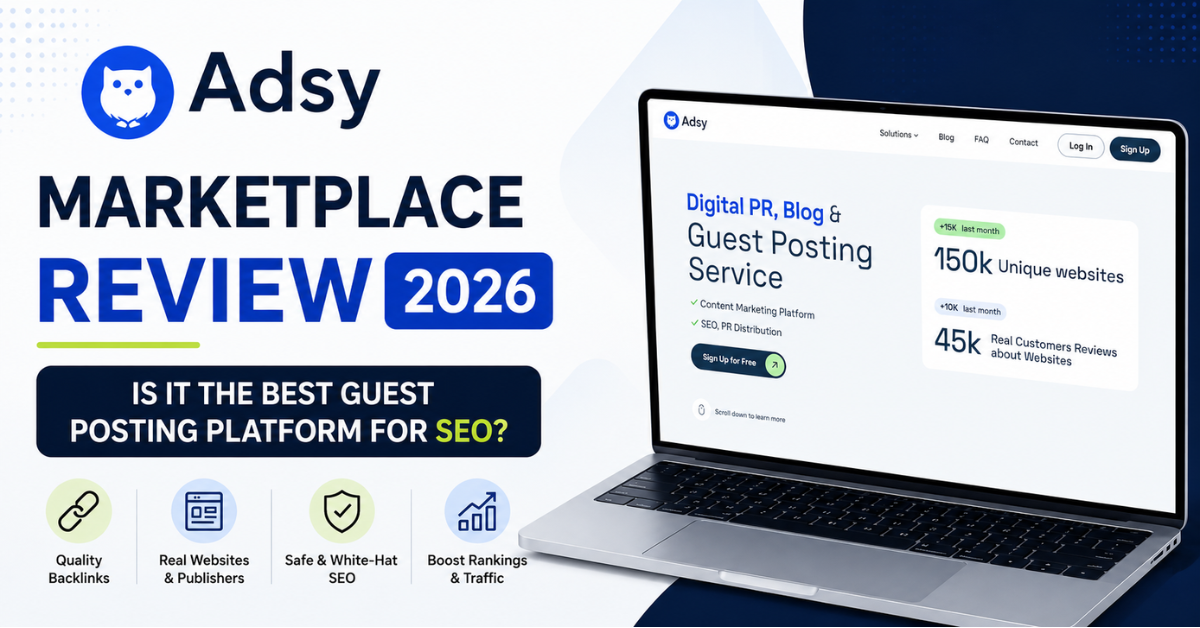
Adsy is a guest post marketplace launched in 2018, connecting advertisers seeking backlinks with publishers hosting paid guest post content. Its database spans 150,000+ websites across 58+ niches, making it a notable platform for guest post link-building campaigns.
It offers a streamlined guest post workflow covering site discovery, outreach, and content placement. Key features include a guest post writing service, publisher quality filters, and niche targeting.
In this detailed review, we analyse Adsy from every angle its interface, publisher quality, guest post pricing model, content writing services, customer support, and the honest drawbacks prospective users should know before committing their budget to a guest post strategy.
Adsy at a Glance: Key Facts
|
Detail |
Information |
|
Founded |
2017 (launched publicly 2018) |
|
Headquarters |
Lewes, Delaware, USA |
|
Publisher Network |
150,000+ websites |
|
Niches Covered |
58+ categories |
|
Starting Price |
$15 per placement |
|
Content Writing |
Available from $25 (platform or publisher writers) |
|
Turnaround Time |
3–5 days (most publications) |
|
Trustpilot Score |
Mostly positive; award-winning customer support |
|
Best For |
Businesses, SEO agencies, freelancers |
|
API |
Available (beta for agencies) |
Platform Interface and User Experience
One of Adsy's consistently praised qualities across multiple independent reviews is the cleanliness and usability of its dashboard. Whether you are an experienced SEO agency manager or a small business owner placing your very first guest post order, the platform is designed to make the process intuitive.
When you log in as an advertiser, you are presented with a searchable, filterable directory of publisher websites. Each listing displays a rich set of metrics that allows you to make informed purchasing decisions without needing to open multiple third-party tools:
- Organic traffic (via Ahrefs and Similar web data)
- Total traffic and traffic trend over time
- Ahrefs Domain Rating (DR)
- Semrush Authority Score (AS)
- Moz Domain Authority (DA)
- Geographic traffic distribution and country breakdown
- Publisher completion rate and turnaround time (TAT)
- Historical link lifetime data
- Work samples from the publisher
Independent testing confirmed that the metrics displayed on the platform closely match data pulled directly from Ahrefs and Similarweb, which means you are not working from inflated or outdated numbers. This level of data transparency is a significant advantage over traditional link-building agencies, which often keep their publisher networks opaque.
The filtering system is another standout. You can slice and dice the publisher database by price range, domain metrics (DR, DA, AS), language, country, niche/category, traffic volume, and whether a publisher is 'verified.' The verified publisher filter is particularly useful for cutting through the noise and zeroing in on the more established, reliable listings.
Publisher Network: Scale, Quality, and the Fine Print
With over 150,000 publisher sites on the platform spanning 58+ niches, Adsy's inventory is undeniably one of the largest in the guest posting marketplace space. For advertisers running campaigns across multiple industries and geographies, this breadth is a genuine asset.
That said, scale and quality do not always move in lockstep, and this is where some distinction is warranted.
The Good: Verified Publishers and Rich Filters
The platform's 'verified publishers' tag helps separate the wheat from the chaff. Verified sites have been reviewed for legitimacy and quality, and filtering exclusively by verified listings dramatically improves the chances of landing on a well-maintained, traffic-generating website.
Real-world testing of the filtering system revealed that with the right criteria applied Semrush Authority Score above a threshold, US-based traffic, relevant niche category, and a price ceiling it was possible to narrow a database of 150,000+ sites down to a shortlist of under 1,000 high-quality candidates. That is a genuinely useful result.
The Less Good: Some Subpar Listings
Where independent testers have pointed out room for improvement is in the overall curation of the marketplace. Despite the volume of listings, a proportion of sites in the database have negligible traffic, weak authority metrics, or appear to exist primarily as link farms. For an experienced SEO professional who knows what to filter for, this is a manageable inconvenience. For newer users who may not know to be sceptical of sites with impressive-looking DA scores but near-zero actual organic traffic, it is a potential pitfall.
Additionally, one reviewer flagged a quirk in the geographic filtering: selecting a country filter does not guarantee that the majority of the site's actual readership is from that country it indicates where the site is registered or categorised. Advertisers targeting specific markets should cross-reference traffic geo-distribution data rather than relying on country filters alone.
Adsy Pricing: Transparent and Pay-As-You-Go
Adsy operates on a pay-as-you-go model. There are no monthly subscriptions, no minimum spends requirements, and no retainer agreements. You pay per placement, with prices set by individual publishers.
Placements start from as low as $15 for entry-level sites, moving up significantly for high-authority websites. Content writing if you choose to have the publisher or Adsy's in-house team write the article is available from around $25 for a 500-word piece, scaling up to $150 or more depending on word count, complexity, and the writer you select.
What makes Adsy's pricing model stand out from traditional link-building agencies is its transparency:
- The price you see when placing an order is the price you pay no hidden fees or agency markups layered on top.
- Funds are held in escrow after you place your order. They are only released to the publisher once you review and approve the published content.
- You have full control over which sites you choose, allowing you to match your budget precisely to your campaign goals.
That said, it is worth noting that pricing across the marketplace is variable. Premium placements on genuinely high-traffic, high-authority sites can command prices well above $200 per post, which may require careful budget planning for smaller businesses. The key advantage is that you always know what you are paying before you commit.
Not sure what a fair price looks like for your niche or domain target? Our detailed guide on how much you should pay for a guest post breaks it down by authority tier and industry.
Content Writing Services: Convenient, But Know the Limitations
Two routes available: Submit your own pre-written article or commission content through the platform.
Commission options: Order content directly from the publisher or from Adsy's dedicated pool of writers.
Time-saving advantage: The platform manages briefing, production, and submission, allowing you to place an order and return to a completed, published article.
Entry-level pricing: Around $25 for a 500-word article, suitable for basic SEO purposes.
Quality at entry level: Content is grammatically correct and coherent but may not fully replicate native American English tone and register.
Writer selection policy: Adsy chooses writers based on skill and work ethic rather than country of origin, which is a fair approach.
Brand consideration: For brands where precise, native-fluency copy is critical, entry-level writing may not be the ideal choice.
Recommendation: Upgrade to a higher writing tier or submit your own content if tone and brand voice accuracy are top priorities.
For higher-budget campaigns where quality content genuinely matters, the recommendation would be to either supply your own polished copy or budget for a more senior writer tier on the platform.
The Ordering Process: Three Ways to Buy
Adsy gives advertisers three distinct pathways to securing a placement, each suited to different workflow styles:
1. Direct Publisher Search
The most popular method. You use Adsy's filtering system to find publishers that match your criteria, then place a direct order specifying your URL, anchor text, and content (or content request). This gives you maximum control and is well-suited to advertisers with clear SEO targets and the ability to evaluate publisher metrics independently.
2. Open Offers
Advertisers can post an open listing of their requirements niche, domain metrics, budget, content guidelines and wait for publishers to apply. In theory, this is an efficient way to attract inbound interest from relevant sites. In practice, the open offer system can attract a high volume of applications from publishers who have not carefully read the requirements. One tester reported receiving over 420 applications for a single open offer, yet struggled to find even a handful that truly matched their relevance criteria. For advertisers with highly specific niche requirements, direct search will typically yield better results than open offers.
3. Content Purchase
A more streamlined order type where the focus is on acquiring written content with a backlink rather than managing the full editorial placement process. Good for advertisers who prioritise volume and speed over highly curated placements.
Customer Support: A Genuine Strength
Across multiple independent reviews and testing scenarios, Adsy's customer support team receives consistently high marks. Response times are described as prompt, replies are substantive, and the team demonstrates a willingness to engage with and resolve disputes rather than deflect them.
This responsiveness extends to public review platforms. On Trustpilot, Adsy has maintained a largely positive reputation, and the team has demonstrated a proactive approach to handling negative feedback engaging with dissatisfied users, resolving issues, and in multiple documented cases, converting negative reviews into positive ones after addressing the underlying problem. This kind of public accountability is a meaningful trust signal.
Adsy also earned Crozdesk's Happiest Users 2025 designation, which is determined by aggregated user satisfaction data rather than a nomination or application process making it a credible independent validation of support quality.
Support is available via email, phone, and a contact form on the website.
Adsy Pros and Cons: The Honest Summary
What Works Well
- Massive publisher inventory with 150,000+ sites across 58+ niches one of the largest in the market.
- Transparent, real-time publisher metrics from Ahrefs, Similarweb, and Semrush, independently verified as accurate.
- Pay-as-you-go pricing with full price visibility before purchase and escrow-protected payments.
- Advanced filtering that genuinely narrows large datasets to actionable shortlists.
- Fast turnaround: most articles go live within 3 to 5 days.
- Clean, beginner-friendly dashboard that does not require prior technical SEO experience to navigate.
- Responsive, award-winning customer support team with strong public review management.
- Highly flexible no subscriptions, no minimum spend, full control over anchors, URLs, and content.
- API access available for agencies needing to integrate Adsy into larger workflow systems.
Where There Is Room for Improvement
- Some subpar publisher listings with weak traffic slip through the curation process careful filtering is essential.
- Geographic country filters do not necessarily reflect where the majority of a site's traffic originates.
- Entry-level content writing ($25) may not meet the quality bar for brands requiring native-fluency, polished copy.
- Open Offers can attract a high volume of irrelevant publisher applications, making the feature less efficient for niche campaigns.
- The feedback function after publication does not support image attachments a minor but notable UX limitation.
- Founders maintain a deliberately low public profile, which some transparency-focused reviewers have flagged as a negative signal.
- Agency API is still in beta, meaning enterprise-scale integration may not yet be fully stable.
Who Is Adsy Best Suited For?
Based on the full picture painted by both platform testing and aggregated user experience, Adsy is an excellent fit for:
- SEO professionals and digital marketing agencies managing multiple client link-building campaigns who need a scalable, self-serve marketplace.
- Small to medium-sized businesses looking to build domain authority without the cost and opacity of a traditional link-building agency.
- Freelance SEO consultants who need a reliable, transparent platform to fulfil client deliverables efficiently.
- Marketers entering new niches or geographic markets who need access to a broad publisher network to identify viable placement opportunities.
It is less ideal for advertisers requiring exclusively premium, editorial-quality content placements on top-tier publications, or those who prefer hands-on account management over a self-serve model. In those cases, a curated boutique link-building agency may serve better though at a significantly higher price point.
OVERALL ADSY RATING
Publisher Network & Scale █████████░ 9/10
Interface & Ease of Use █████████░ 9/10
Data Transparency ████████░░ 8/10
Pricing & Value ████████░░ 8/10
Customer Support █████████░ 9/10
Content Writing Quality ██████░░░░ 6/10
Publisher Curation ███████░░░ 7/10
Founder Transparency █████░░░░░ 5/10
Overall Score: 7.6 / 10 Recommended
Final Verdict: Is Adsy Worth It?
Adsy is a strong guest posting marketplace offering a vast publisher database, transparent pricing, fast turnaround, and responsive support making it a solid choice for SEO professionals pursuing link-building at scale.
Its main drawbacks are variable publisher quality and limitations in entry-level content writing. However, for those who understand SEO metrics and have a clear strategy, Adsy delivers excellent value.
Its escrow payments, real-time data, and marketplace breadth make it a worthy addition to any serious SEO toolkit.
If you are still comparing options, our independent roundup of the top 19 link building marketplaces will help you see exactly how Adsy stacks up against the competition.
For more expert SEO platform reviews, link-building guides, and digital marketing insights, visit WebLinkBuzz.