
Site added
Introduction: More Content Doesn't Automatically Mean More Authority
For years, content marketing often followed a simple formula:
Find a keyword → write an article → publish it → move on to the next keyword.
That approach can produce a large content library, but more URLs don't automatically create more topical authority.
A better approach is to build a connected information system where each page answers a different question and helps the reader move naturally to the next stage of research.
This matters even more as search evolves.
Google's current guidance for generative AI features emphasizes the same foundational SEO principles that apply to traditional Search: useful, unique, people-first content, clear organization, crawlability, and strong user experience. Google also warns against creating large numbers of pages simply to capture different search variations.
For a website focused on backlink research and pricing, that creates a practical opportunity.
Instead of publishing dozens of loosely related SEO articles, you can build a focused content cluster around one central subject:
backlink pricing and comparison.
The goal isn't to publish more.
The goal is to make every useful page strengthen the next one.
What Is an AI-Ready Content Cluster?
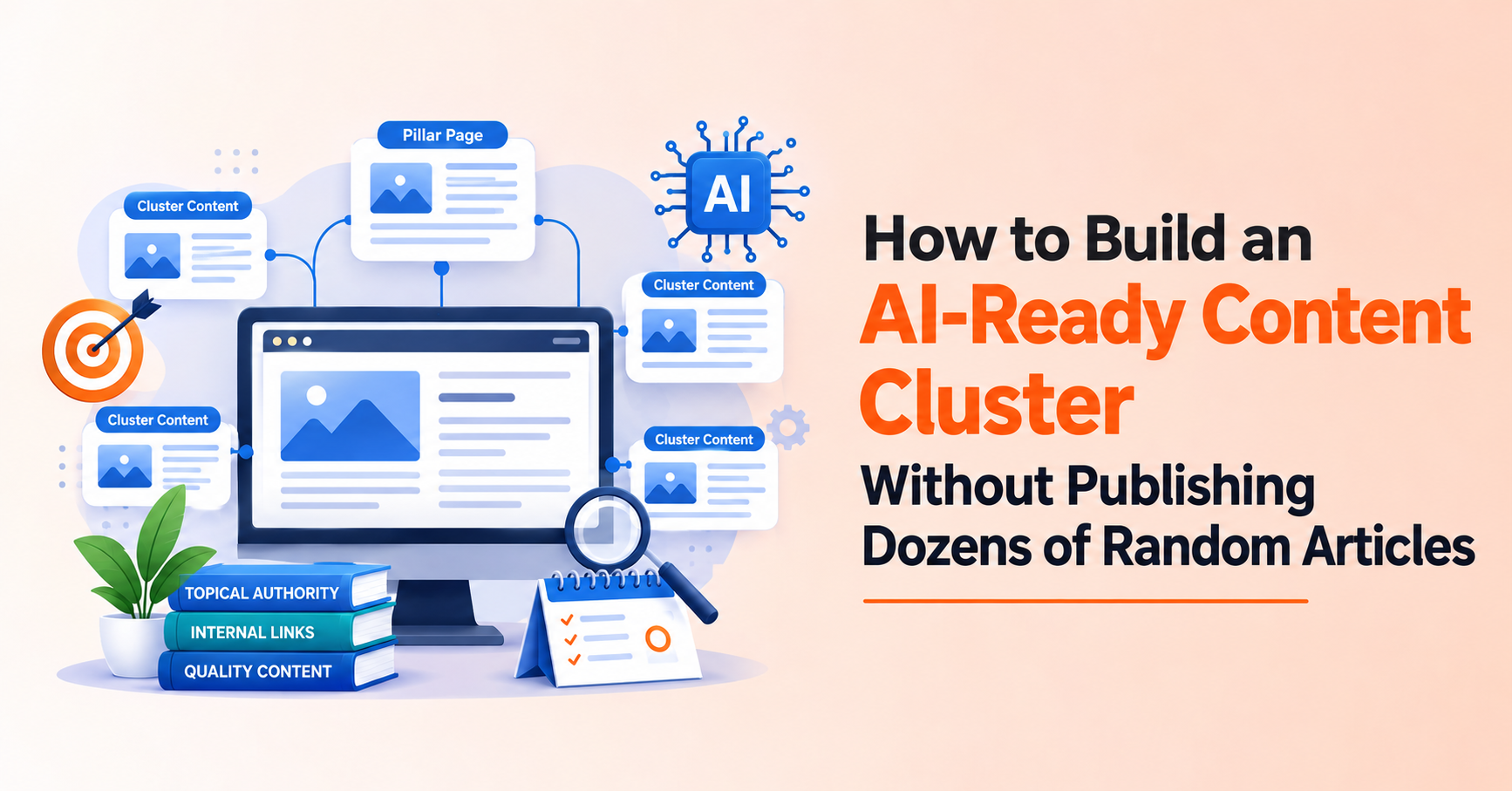
An AI-ready content cluster is a group of closely related pages organized around a central topic, with each page answering a different but connected search question.
Think of it as a knowledge structure rather than a collection of blog posts.
For example, a backlink-pricing cluster could have:
Core topic: Backlink pricing and comparison
• What determines the price of a backlink?
• How do you check backlink price?
• How much should a guest post cost?
• Why do different marketplaces charge different prices?
• How should you compare backlinks?
• Does a higher-authority website always justify a higher price?
• Which metrics should you evaluate before buying a backlink?
• How should you build a backlink budget?
Each page has a distinct purpose.
Together, they create a clearer information architecture around the broader topic.
Why Random Blog Publishing Doesn't Build Strong Topical Authority
Imagine a website publishes:
• 10 Best SEO Tools
• How to Improve Rankings
• What Is Domain Authority?
• SEO Trends for 2026
• How to Write Meta Descriptions
• Best Link-Building Strategies
• What Is Guest Posting?
• How to Do Keyword Research
These topics are all related to SEO. But they don't necessarily create strong topical depth around backlink pricing.
Now compare that with a focused cluster:
• What Determines Backlink Pricing?
• How to Check Backlink Price
• Backlink Price Checker Guide
• Guest Post Price Checker Guide
• Why Backlink Prices Differ Across Marketplaces
• How to Compare Backlink Prices
• DR vs Traffic vs Backlink Price
• How Much Should You Pay for a Backlink?
• How to Build a Backlink Budget
The second structure creates a much clearer topical neighborhood.
The lesson is simple: Topical authority isn't about publishing the highest number of articles. It's about covering the right subject comprehensively and connecting the information logically.
Step 1: Start With One Core Search Intent
Before creating a content cluster, identify the central problem you're solving.
For a backlink-pricing website, that problem might be:
“I want to understand how much a backlink or guest post costs and compare available options before making a purchase.”
That creates a clear set of related topics:
• backlink pricing
• guest post pricing
• backlink comparison
• publisher metrics
• marketplace pricing
• link quality
• SEO budgets
• backlink research
• pricing tools
The backlink price checker then becomes more than a keyword target.
It becomes the commercial resource at the center of the information ecosystem.
Step 2: Build Your Cluster Around Questions, Not Just Keywords
One of the biggest mistakes in content planning is creating a separate article for every slight keyword variation.
For example:
• backlink pricing checker
• check backlink price
• backlink price checking tool
These queries may have significant intent overlap. Creating four nearly identical articles could create unnecessary duplication and make your site's information architecture less clear.
Instead, map keywords to different questions and stages of the user's journey.
|
Search Stage |
User Need |
Content Type |
Example |
|
Understand |
Learn the fundamentals |
Educational |
What Determines the Price of a Backlink? |
|
Research |
Evaluate pricing |
Guide |
How to Check Backlink Price Before Buying |
|
Compare |
Compare options |
Comparison |
How to Compare Backlink Prices |
|
Evaluate |
Judge value |
Data-driven |
DR vs Traffic vs Backlink Price |
|
Purchase |
Make a decision |
Commercial |
How to Choose a Backlink Within Your Budget |
|
Use |
Perform the task |
Tool |
Backlink Price Checker |
Step 3: Create a Strong Pillar Page
Your pillar page should provide the broadest useful explanation of the subject.
For WeblinkBuzz, a strong pillar concept could be:
Backlink Price Checker: How to Compare Backlink Costs Before Buying
The page can explain:
• What backlink pricing means
• Why prices vary
• Factors influencing price
• Domain Authority
• Domain Rating
• Organic traffic
• Niche relevance
• Publisher quality
• Marketplace differences
• Placement type
• How to compare listings
• How a backlink price checker works
Then supporting articles can explore individual questions in greater depth.
The structure becomes: Pillar page → Supporting article → Deeper answer → Tool/action
Step 4: Create Supporting Content With Distinct Jobs
A strong cluster doesn't need 30 articles. It needs enough genuinely useful pages to cover the important questions surrounding the topic.
Cluster A: Backlink Pricing Fundamentals
1. What Determines the Price of a Backlink?
Explain the factors that influence pricing: website authority, organic traffic, niche, publisher demand, content requirements, link placement, marketplace, and audience quality.
2. Why Do Backlink Prices Vary So Much Between Websites?
Explain why two websites with apparently similar metrics can have very different prices.
3. How Much Should You Pay for a Backlink?
Avoid presenting one universal price. Instead, explain how buyers should evaluate price relative to quality, relevance, traffic, and placement conditions.
Cluster B: Backlink Price Checking
4. How to Check Backlink Price Before Buying
• Identify the target domain.
• Review relevant SEO metrics.
• Check organic traffic.
• Examine niche relevance.
• Compare listed prices.
• Check multiple marketplaces.
• Evaluate overall value.
• Make the purchase decision.
The goal is to move the reader from “What does this link cost?” to “Is this link fairly priced for what I'm getting?”
Cluster C: Guest Post Pricing
5. Guest Post Price Checker: How to Compare Publisher Rates
Cover guest post cost, website authority, traffic, niche, content requirements, link placement, turnaround time, and marketplace differences.
The key idea should be that price alone doesn't determine value.
A $50 placement isn't automatically a better deal than a $150 placement. The real question is what the additional $100 provides.
Cluster D: Data and Comparison
6. Why the Same Website Can Have Different Backlink Prices Across Marketplaces
This is particularly valuable for WeblinkBuzz because price comparison is central to the product. Instead of simply making the claim, demonstrate it with actual marketplace observations whenever possible.
7. DR vs Traffic vs Price: Which Metric Matters Most?
Move the conversation beyond domain metrics. A website with a high DR but declining organic traffic may deserve a different evaluation from a highly relevant site with stronger current traffic.
8. Cheap vs Expensive Backlinks: What Are You Actually Paying For?
Compare authority, traffic, relevance, content quality, placement, publisher requirements, turnaround, and marketplace pricing. The goal is to teach readers to evaluate value rather than price alone.
Step 5: Create a Strategic Internal Linking Network
Internal linking is where the cluster becomes a connected system.
Don't link every article to every other article. Create meaningful relationships.
Example:
Backlink Pricing Pillar → What Determines Backlink Pricing? → How to Check Backlink Price → Guest Post Pricing → Marketplace Comparison → DR vs Traffic vs Price → Backlink Budget
Each supporting page should link back to the pillar where appropriate. It should also link to other supporting pages when the reader genuinely needs additional information.
For example: “Before comparing publisher rates, it helps to understand the factors that influence backlink pricing.” The phrase can naturally link to the relevant article.
The link exists because the reader needs the additional context—not simply because the page needs another internal link.
Step 6: Make Every Article Answer a Different Question
Before publishing any new article, ask: “What information will this page provide that another page in my cluster doesn't?”
If the answer isn't obvious, stop. The article may need to be merged with another page, repositioned around a different intent, expanded with genuinely new information, or removed from the content plan.
|
Page |
Primary Purpose |
|
Backlink Price Checker |
Tool/action |
|
What Determines Backlink Pricing? |
Education |
|
How to Check Backlink Price |
Process |
|
Guest Post Price Checker |
Guest post research |
|
Why Prices Differ |
Explanation |
|
DR vs Traffic vs Price |
Evaluation |
|
Cheap vs Expensive Links |
Comparison |
|
Backlink Budget Guide |
Planning |
|
Marketplace Pricing Guide |
Market research |
Step 7: Structure Content for Search and AI Systems
You don't need to write for an “AI bot.” You need to make the information clear, useful, well-organized, and easy to understand.
Google's current documentation states that there are no special technical requirements or special optimization techniques required for inclusion in AI Overviews or AI Mode beyond being indexed and meeting Google's normal Search requirements. It recommends continuing to apply foundational SEO practices.
Give direct answers
Instead of spending 500 words explaining a concept before defining it, answer the question first.
A backlink price checker is a tool that helps SEO professionals research and compare the listed costs of backlink or guest post placements across websites or marketplaces.
Use descriptive headings
Weak: Things to Know
Better: What Factors Affect Backlink Prices?
Use tables when comparisons matter
Tables can make relationships between metrics, prices, and options easier to understand.
Define important terms
• Backlink
• Guest post
• Domain Authority
• Domain Rating
• Organic traffic
• Referring domains
• Backlink pricing
Step 8: Add Original Data Instead of More Generic Advice
This is one of the biggest opportunities for WeblinkBuzz.
Generic statement: “Backlinks can be expensive.” isn't particularly useful.
Original market data is much more valuable.
For example, WeblinkBuzz could analyze 100 websites across multiple marketplaces and compare listed backlink price, DR, organic traffic, niche, marketplace, and price differences.
Then publish findings such as: “The same domain was listed at different prices across marketplaces.”
Even better, show the actual numbers.
|
Metric |
WeblinkBuzz Research |
|
Websites analyzed |
X |
|
Marketplaces compared |
X |
|
Domains with price differences |
X |
|
Average price difference |
X% |
|
Largest observed difference |
X% |
|
Most common pricing factor |
X |
Important: Replace the X values with actual WeblinkBuzz data before publication. Don't publish invented statistics.
This is where WeblinkBuzz can move beyond generic SEO commentary and demonstrate first-hand market knowledge.
Step 9: Avoid Keyword Cannibalization
Your website may target terms such as backlink price checker, check backlink price, backlink price checking tool, and guest post price checker. Don't force all of them onto every page.
|
Page |
Primary Target |
|
Backlink Price Checker tool |
backlink price checker |
|
Pricing guide |
backlink pricing |
|
Process article |
check backlink price |
|
Guest post article |
guest post price checker |
|
Content cluster article |
AI-ready content cluster |
Related phrases can appear naturally where they genuinely help the reader.
Step 10: Connect the Cluster to WeblinkBuzz Naturally
The product shouldn't interrupt the article. It should appear when the reader reaches the point where a tool becomes useful.
Once you've identified the metrics that matter, the next challenge is comparing prices efficiently. Manually checking multiple websites and marketplaces can take considerable time. WeblinkBuzz can help simplify this research by bringing backlink pricing information into a comparison-focused workflow.
The positioning should be: Problem → Education → Evaluation → Tool.
How WeblinkBuzz Fits Into the Workflow
• Find potential publishers
• Review relevance and website metrics
• Check the listed backlink or guest post price
• Compare prices across available options
• Evaluate price against traffic, authority, relevance, and placement
• Choose the option that provides the best overall value
The WeblinkBuzz backlink price checker can serve as the commercial step within that workflow.
The purpose isn't simply to find the cheapest link. It's to make better-informed pricing decisions.
What Makes a Content Cluster “AI-Ready”?
There isn't a secret keyword density, AI prompt, or special formula that guarantees visibility in AI search.
Instead, focus on making the information genuinely useful and easy to understand.
• Clear topical focus — Every page should contribute to the central subject.
• Distinct search intent — Don't create multiple pages that answer essentially the same question.
• Strong information architecture — Users should move naturally from broad concepts to specific answers.
• Direct answers — Answer important questions clearly before expanding.
• Original information — Use first-party data, examples, research, experiments, or observations whenever possible.
• Credible sources — Support factual claims with trustworthy references.
• Consistent terminology — Use related concepts naturally rather than forcing the same phrase repeatedly.
• Useful internal links — Connect related information when the relationship is genuinely useful.
Example: An AI-Ready Content Cluster for WeblinkBuzz
BACKLINK PRICING & COMPARISON
1 Pricing Fundamentals
a.What Determines Backlink Pricing?
b. Why Do Backlink Prices Differ?
1. How Much Should You Pay for a Backlink?
a.Price Checking
b. How to Check Backlink Price
2. Guest Posts
a.Guest Post Price Checker
b. Price Comparison
3. Marketplace Price Differences
a.DR vs Traffic vs Price
b.Cheap vs Expensive Backlinks
4. WEBLINKBUZZ
The important point is that every article has a job.
Content Cluster Checklist
Topic
• Does the article support the main topic?
• Does it answer a distinct question?
• Is the search intent clear?
• Does an existing page already answer the same question?
Content
• Does the introduction answer the user's problem?
• Are important terms clearly explained?
• Are examples included?
• Are tables useful?
• Is there original insight or data?
• Does the page add something beyond information already available elsewhere?
SEO
• Is the primary topic naturally represented?
• Are related terms used where relevant?
• Is the title descriptive?
• Is the meta description useful?
• Are headings logically structured?
• Are internal links relevant?
• Is the page technically crawlable and indexable?
AI Search
• Are important questions answered directly?
• Can readers quickly understand the key information?
• Are factual claims supported where appropriate?
• Does the article provide original information?
• Does it demonstrate genuine experience or expertise?
Conversion
• Does the reader have a logical next step?
• Is WeblinkBuzz introduced naturally?
• Does the CTA match the reader's intent?
Final Takeaway
The future of content strategy isn't about publishing the most articles.
It's about building the most useful information network around a subject.
For a website focused on backlink research and pricing, that means creating a connected ecosystem around: