
Site added
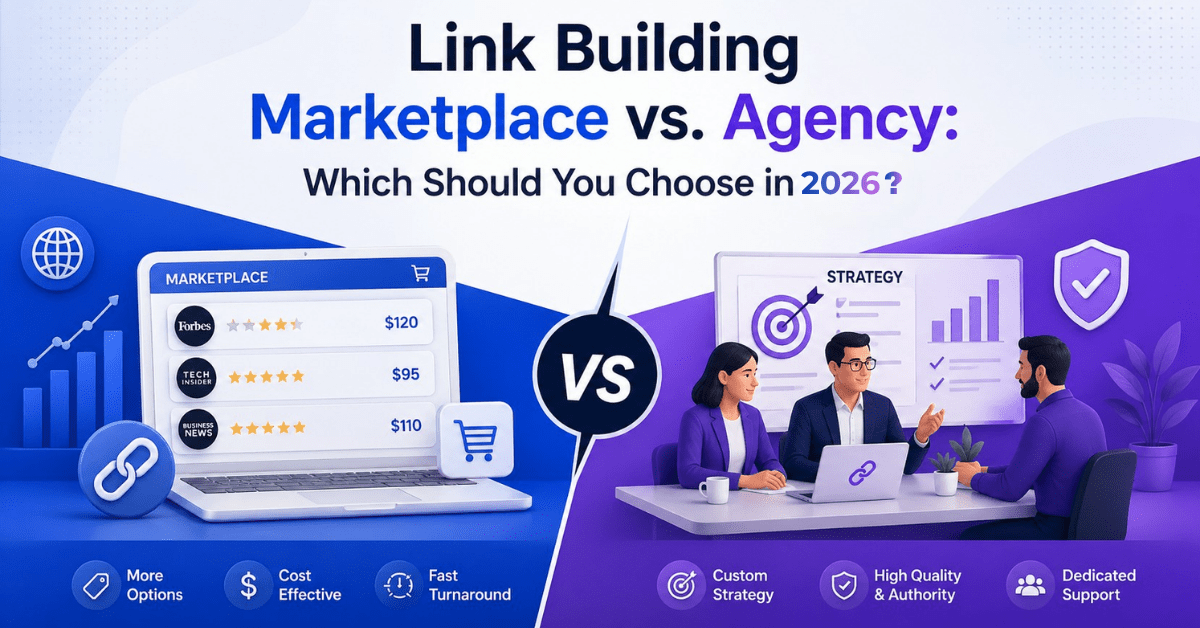
Backlinks remain one of the strongest ranking factors in Google's algorithm. Yet choosing how to acquire them has become more complicated than choosing which ones to acquire, especially with the rise of tools like a backlink price checker and platforms offering backlink price comparison insights. Two dominant models have emerged: the link building marketplace and the link building agency. Each operates differently, prices differently, and delivers differently.
Picking the wrong model wastes budget, delays results, and can damage domain authority if quality standards slip. According to a 2024 Ahrefs study, 66.5% of links built over the past nine years are "dead," indicating high link rot — making the sourcing method a critical strategic decision, not just a procurement choice when you buy contextual backlinks.
This guide breaks down both models across cost, control, quality, scalability, and turnaround time so you can make an informed decision based on your specific needs and budget.
What Is a Link Building Marketplace?
A link building marketplace is an online platform that connects buyers directly with website publishers willing to place backlinks on their sites, often referred to as a marketplace backlink ecosystem. Buyers browse publisher listings, filter by domain authority (DA), niche, traffic, and price, then purchase placements directly without an intermediary managing the process, sometimes using a built-in backlink price checker for smarter decisions.
Marketplaces operate on a self-service model. The buyer selects the publisher, approves the placement, and often provides or approves the content. Examples of this model include platforms like Accessily, Vefogix, Collaborator, and Adsy. Pricing is transparent — listed per placement — and the buyer retains full control over which domains are selected, making backlink price comparison easy and efficient.
This model is most commonly used by in-house SEO teams, freelancers, and small agencies that have the expertise to evaluate publishers independently and prefer granular control over each placement, especially when they want to buy contextual backlinks at scale.
What Is a Link Building Agency?
A link building agency is a service provider that manages the entire backlink acquisition process on behalf of the client, often positioning themselves among the Best guest post services in the market. Agencies handle outreach, publisher vetting, content creation, placement, and reporting as a managed service. The client provides goals and guidelines; the agency executes.
Agencies typically charge monthly retainers or per-link packages. The client receives a set number of placements per month at agreed-upon DA tiers. Examples include OutreachMonks, The Hoth, Loganix, and Page One Power. Pricing is higher per link than marketplace rates because it includes labor, outreach infrastructure, and project management overhead.
This model suits businesses that lack in-house SEO expertise, prefer a hands-off approach, or need consistent monthly link velocity without dedicating internal resources to outreach.
Link Building Marketplace vs. Agency: Full Comparison
The differences between a link building marketplace and a link building agency become clearest when evaluated across specific operational criteria.
|
Criteria |
Marketplace |
Agency |
|
Cost per link |
$30–$500 (varies by DA) |
$150–$1,000+ (includes service fee) |
|
Control over publishers |
Full — buyer selects each site |
Limited — agency selects based on brief |
|
Content creation |
Buyer provides or pays extra |
Included in package |
|
Turnaround time |
3–10 days per placement |
2–6 weeks per campaign cycle |
|
Minimum commitment |
None — pay per placement |
Monthly retainer or package minimum |
|
Scalability |
High — limited only by budget |
Moderate — limited by agency capacity |
|
Transparency |
Full pricing and publisher metrics visible, often with backlink price comparison tools |
Varies — some agencies share, others don't |
|
Quality control |
Buyer's responsibility |
Agency's responsibility |
|
Best for |
Experienced SEO teams |
Businesses without SEO expertise |
Cost: Marketplace Wins on Price Per Link
The most significant difference is cost. Marketplaces eliminate the intermediary markup. A DA 40+ guest post that costs $80–$150 on a marketplace may cost $300–$500 through an agency because the agency adds outreach labor, content writing, and project management fees.
However, the agency price includes services that the marketplace buyer must handle independently: publisher vetting, content creation, placement tracking, and quality assurance. For buyers who lack the time or expertise to manage these tasks, the agency premium can represent fair value, especially when compared against Best guest post services.
Rule of thumb: If your team can evaluate DA, traffic quality, and spam metrics independently, a marketplace delivers more links per dollar. If your team cannot, an agency provides the expertise as part of the cost.
Quality: Agency Wins on Vetting (With Caveats)
Reputable agencies maintain curated publisher networks and vet sites for spam, traffic authenticity, and relevance before placing links. This reduces the risk of acquiring links from PBNs, link farms, or de-indexed domains.
Marketplaces shift this responsibility to the buyer. Most platforms provide DA, traffic, and niche filters, but the buyer must verify metrics independently using tools like Ahrefs, SEMrush, or Moz before they buy contextual backlinks. Experienced SEO professionals often prefer this control because they can apply their own vetting standards rather than relying on an agency's judgment.
The caveat: Not all agencies maintain high standards. Some prioritize volume over quality to hit monthly targets. Always request sample placement reports and verify the domains independently before committing to a retainer.
Scalability: Marketplace Wins
Marketplaces allow unlimited scaling. A buyer can purchase 5 links or 500 links in the same week, limited only by budget and publisher availability. There are no capacity constraints because the platform aggregates thousands of publishers in a marketplace backlink network.
Agencies are constrained by team size, outreach bandwidth, and existing client load. Scaling from 10 links per month to 50 requires the agency to allocate additional resources, which often means longer timelines, waitlists, or increased retainers.
For campaigns requiring rapid link velocity — such as product launches, competitive niches, or time-sensitive SEO pushes — marketplaces offer faster execution at scale.
When to Choose a Marketplace
A link building marketplace is the right choice when:
- The buyer or team has SEO experience and can evaluate publisher quality independently
• Budget efficiency is a priority and cost per link matters more than convenience
• The campaign requires rapid scaling without monthly commitments
• The buyer wants full transparency and control over which domains are selected, often using a backlink price checker
• The project is short-term or campaign-specific rather than ongoing
When to Choose an Agency
A link building agency is the right choice when:
- The business lacks in-house SEO expertise to vet publishers and evaluate link quality
• A hands-off, managed service approach is preferred
• Consistent monthly link velocity is needed with reporting and accountability
• The budget accommodates agency premiums in exchange for reduced internal workload
• The business values an ongoing strategic partnership rather than transactional purchases from a marketplace backlink platform
Conclusion
The choice between a link building marketplace and a link building agency depends on three factors: internal SEO expertise, budget constraints, and the level of control required. Marketplaces deliver more links per dollar with full transparency and no commitments, often supported by backlink price comparison systems. Agencies deliver managed execution with built-in quality control and strategic guidance.
For experienced SEO teams operating on performance-driven budgets, marketplaces offer the best combination of cost efficiency and scalability. For businesses without dedicated SEO resources, agencies provide the expertise and accountability needed to build links safely and consistently.
Evaluate your team's capabilities, define your monthly link targets, and choose the model that aligns with your operational capacity — not just your budget.