
Site added
A backlink can look valuable on paper and still deliver less SEO value than expected. A strong domain rating, steady traffic, or a large referring-domain profile does not automatically make every link from that website useful.
The problem often sits at the page level. The specific page containing a backlink may be poorly indexed, irrelevant to the destination, overloaded with outbound links, redirected, technically inaccessible, or missing the contextual signals that make the link meaningful.
A technical backlink audit helps uncover these hidden problems before they affect your SEO strategy.
For SEO teams managing large backlink profiles, an SEO backlink checker can make this process more efficient by bringing link-level information into one workflow. When hundreds or thousands of links need evaluation, a bulk backlink checker can also help identify patterns that are difficult to spot manually.
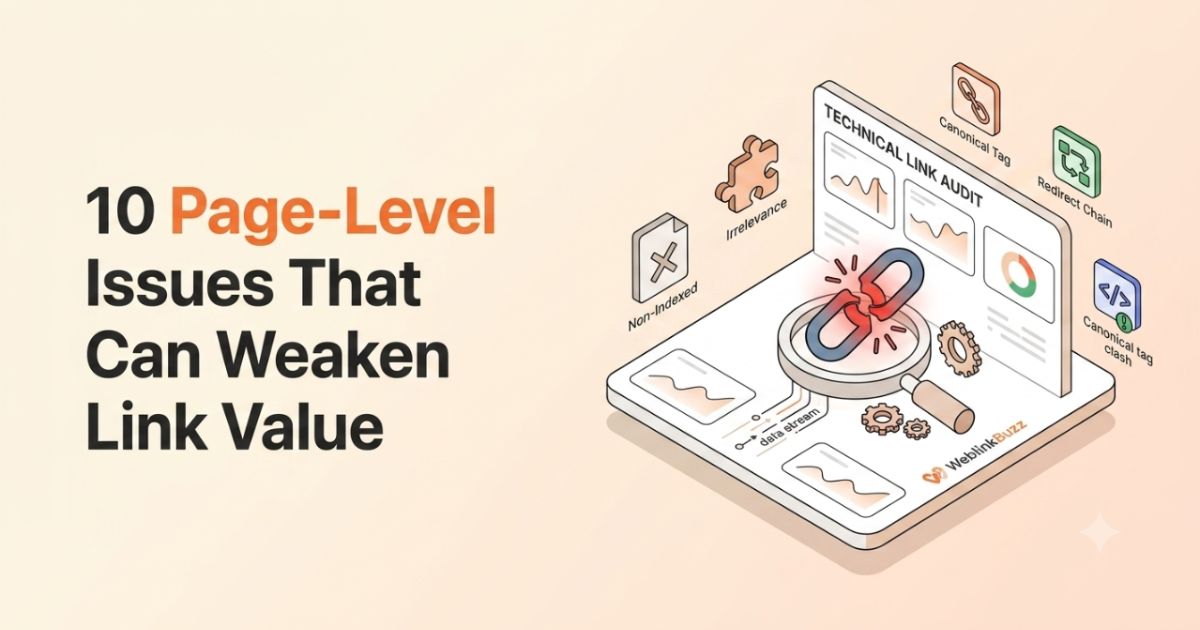
This guide explains the 10 page-level issues worth checking and shows how to build a practical backlink health audit around them.
What Is a Technical Backlink Audit?
A technical backlink audit evaluates the health and quality of individual links by examining both the referring page and the destination page.
Instead of asking only, “Does this website have a good authority score?”, a stronger audit asks, “Is this specific page relevant, accessible, indexable, technically sound, and providing a useful connection to the destination page?”
This distinction matters because domain-level metrics provide a broad picture, while page-level checks reveal what is happening where the backlink actually exists.
· Referring page status
· Destination URL status
· Indexability
· Redirects
· Canonicalization
· Link attributes
· Anchor text
· Topical relevance
· Link placement
· Surrounding content
· Outbound-link patterns
· Changes to the linking page
The goal is not to label every imperfect backlink as harmful. Instead, identify links that deserve attention, understand why they may be weak, and prioritize the right actions.
Why Domain-Level Metrics Are Not Enough
SEO professionals often begin backlink research with Domain Rating, Domain Authority, organic traffic, or referring-domain counts. These metrics can be useful for prospecting, but they do not describe every page equally.
A website with strong authority can contain pages that are outdated, poorly indexed, irrelevant, or technically problematic. A page-level audit therefore adds an important layer of analysis.
Domain-level signals vs. page-level signals
|
Domain-level signal |
Page-level question |
|
Domain authority |
Is the specific page relevant? |
|
Organic traffic |
Does the linking page receive meaningful visibility? |
|
Referring domains |
Is the page itself authoritative or useful? |
|
Domain relevance |
Does the surrounding content support the link? |
|
Website quality |
Is the actual URL technically healthy? |
10 Page-Level Issues That Can Weaken Link Value
1. The Linking Page Is Not Properly Indexed
One of the first checks in a technical backlink audit should be whether the referring page can actually be discovered and indexed by search engines.
A backlink can exist in the HTML while the page itself has limited search visibility.
· noindex directives
· Incorrect robots directives
· Crawl restrictions
· Orphaned pages
· Duplicate pages
· Pages removed from the index
· Incorrect canonical implementation
Real-world example: A publisher places your backlink on an article, but later adds a noindex directive to that page. The URL may still open normally for users, yet its search visibility needs investigation.
What to do: Check the page's indexability, crawl signals, canonical, and current search visibility.
2. The Referring URL Returns an Unexpected Status Code
A backlink audit should verify the HTTP status of the referring page. A healthy live page will generally return a successful response, while other responses may indicate problems.
· 200 — successful response
· 301/308 — permanent redirect
· 302/307 — temporary redirect
· 404 — page not found
· 410 — permanently removed
· 5xx — server-side error
For Example: A backlink originally exists on seo-guide. Months later, that URL returns 404 after the publisher removes the article. The domain may still have strong metrics, but the specific backlink needs attention.
What to do: Verify the current HTTP response and investigate unexpected redirects or errors.
3. The Link Appears in Irrelevant Content
Relevance is one of the most important considerations when evaluating a backlink. A website may operate in a related industry, but that does not mean every page on the website is relevant to every destination.
This is where contextual link building becomes important.
For Example: An article about technical SEO links to a guide about backlink auditing. The relationship is easy for the reader to understand. By contrast, an unrelated link inserted into an article about gardening has little topical connection.
What to do: Read the paragraph around the link and ask whether the destination genuinely helps the reader.
4. The Link Is Buried in an Unhelpful Location
Where a link appears on a page can affect its practical usefulness. A relevant link within the main body of an article creates a different user experience from a link hidden in an unrelated sidebar or buried in a long resource list.
· Is the link easy for readers to find?
· Does it support the surrounding paragraph?
· Is it surrounded by relevant information?
· Does the placement look editorial?
· Does it contribute something useful to the reader?
For Example: A backlink appears naturally inside a paragraph explaining a technical concept. Another link sits in a generic footer containing dozens of unrelated destinations. The placements deserve different levels of scrutiny.
What to do: Evaluate placement alongside relevance and page purpose.
5. The Page Contains an Excessive Number of Outbound Links
A page with many external links is not automatically low quality. However, an unusually high volume of unrelated outbound links can be an investigation signal.
· Number of external links
· Relevance of destinations
· Editorial purpose
· Commercial-link concentration
· Overall page quality
· Whether the page appears primarily built to host links
For Example: A 1,500-word tutorial contains five relevant external references. Another page of similar length contains hundreds of unrelated commercial links. The second page deserves deeper review.
What to do: Look at the page's purpose and link pattern rather than applying an arbitrary maximum.
6. The Link Uses an Unexpected Attribute
Technical backlink audits should examine link attributes such as nofollow, sponsored, and UGC. These attributes provide search engines with information about the nature of a link.
A nofollow link should not automatically be considered worthless. It can still generate referral traffic, visibility, brand exposure, and discovery opportunities.
For Example: A sponsored placement appropriately uses a sponsored attribute, while a user-generated forum link may use UGC. The attribute should match the relationship and method of publication.
What to do: Check whether the attribute accurately reflects how the link was created.
7. The Anchor Text Does Not Match the Destination
Anchor text provides context about the destination page. If a link uses “technical SEO audit” but sends users to a page about social media advertising, the source, anchor, and destination do not align.
· Brand names
· Page titles
· Descriptive phrases
· Partial keyword variations
· Generic phrases where appropriate
For Example: A paragraph about backlink auditing links to a detailed backlink audit guide using descriptive anchor text. That creates a clear connection between the source and destination.
What to do: Favour natural, descriptive anchors rather than forcing exact-match keywords into every backlink.
8. The Linking Page Has Weak Topical Relevance
A strong backlink profile is not simply a collection of links from websites with high authority. Topical relationships matter too.
A backlink to an SEO resource from a page about search engine optimization, digital marketing, content marketing, link building, or analytics has an obvious connection. An unrelated page deserves more scrutiny.
For Example: A digital marketing article references an SEO backlink analysis resource because the resource expands on a concept discussed in the article. The topical relationship is clear.
What to do: Evaluate both domain relevance and the relevance of the individual referring page.
9. Canonicalization Creates Confusion
Canonical tags help search engines identify a preferred URL among duplicate or similar versions. A backlink deserves closer review when the source page has unusual canonicalization, conflicting URL versions, or a canonical pointing elsewhere.
· HTTP vs. HTTPS versions
· URL parameters
· Duplicate page versions
· Alternate URLs
· Canonical pointing to another page
For Example: A backlink exists on `/seo-tips/`, but the page's canonical points to `/seo-guide/`. This does not automatically invalidate the backlink, but it indicates that another URL is being presented as the preferred version.
What to do: Compare the backlink URL, canonical URL, redirects, and page content.
10. The Page Changed After the Backlink Was Acquired
A backlink that looked strong six months ago may not look the same today. Publishers can rewrite articles, change anchors, remove surrounding context, change destinations, add redirects, remove links, or change canonical settings.
· Article rewritten
· Anchor changed
· Surrounding content removed
· Destination URL changed
· Redirect added
· Backlink removed
· Canonical changed
· Page purpose changed
For example: A publisher updates an old article and removes the paragraph that originally made your backlink relevant. The link may still exist, but its context has changed.
What to do: Recheck important backlinks periodically rather than treating acquisition as the end of the process.
How an SEO Backlink Checker Helps Identify Hidden Problems
Manually checking a handful of backlinks is manageable. Checking hundreds is a different problem.
An SEO backlink checker can organize backlink information so SEO professionals can investigate referring URLs more efficiently. Depending on the tool, useful data may include:
· Referring URL
· Target URL
· Anchor text
· Link status
· Link attributes
· Referring domain
· Domain metrics
· Page metrics
· First-seen date
· Last-seen information
The tool should support investigation, not replace judgment. Metrics can surface patterns, but humans still need to determine whether a link is genuinely relevant and useful.
When Should You Use a Bulk Backlink Checker?
A bulk backlink checker becomes particularly useful when a backlink profile contains hundreds or thousands of URLs. Instead of opening every referring page manually, bulk analysis can organize larger datasets and surface patterns faster.
What can you look for in bulk?
· Broken referring pages
· Redirected URLs
· Repeated referring domains
· Unexpected anchor text
· Groups of links from similar pages
· Missing or changed links
· Unusual link attributes
· Pages with questionable relevance
For example, several broken backlinks may look like isolated incidents when reviewed individually. A bulk report can reveal that many links share the same issue.
Contextual Link Building: Why Page Relevance Matters
Contextual link building focuses on links that naturally fit within relevant content. A useful contextual relationship connects the source topic, the paragraph containing the link, and the destination resource.
What makes a link contextual?
1. Source topic: The article discusses a subject related to the destination.
2. Link context: The surrounding paragraph gives the reader a reason to visit the destination.
3. Destination relevance: The linked page logically continues the reader's research.
Are contextual backlinks always better?
Not necessarily. There is no universal rule that one link type is automatically better in every situation. Evaluate relevance, editorial context, page quality, technical accessibility, user usefulness, and link attributes together.
Domain Metrics vs. Page-Level Backlink Analysis
|
Audit level |
What to evaluate |
|
Domain |
Authority, relevance, traffic, reputation |
|
Page |
Topic, indexing, status, content quality |
|
Link |
Anchor, placement, attributes |
|
Destination |
Relevance, accessibility, content quality |
|
Context |
Relationship between source and target |
A useful audit combines both levels. This prevents one authority metric from dominating the evaluation.
A Practical 5-Step Technical Backlink Audit
Step 1 — Collect your backlink data
Start with current referring URLs, destination URLs, anchor text, and available metrics.
Step 2 — Verify the referring page
Check whether the page loads correctly, remains published, is relevant, and contains the expected backlink.
Step 3 — Check the link itself
Review anchor text, destination, link attribute, placement, and redirect behaviour.
Step 4 — Evaluate the context
Read the paragraph around the link and ask whether it genuinely helps the reader understand or explore the topic.
Step 5 — Prioritize the findings
Separate issues that require immediate investigation from those that only need monitoring.
Backlink Health Audit Checklist
· Is the referring page accessible?
· Does the page return an expected HTTP status?
· Is the page indexable?
· Is the topic relevant?
· Does the backlink still exist?
· Does the anchor describe the destination naturally?
· Is the link placed in useful content?
· Is the link attribute appropriate?
· Does the destination URL work?
· Are redirects configured correctly?
· Does canonicalization make sense?
· Has the page changed since the link was acquired?
· Does the page contain an unusually high number of outbound links?
Where WeblinkBuzz Fits Into the Research Process
Backlink health is only one part of link-building research. Before pursuing a publishing opportunity, SEO professionals may need to compare potential websites, available metrics, pricing, and publishing information.
That creates a useful two-stage process: first compare opportunities, then technically validate the pages and links that matter most. WeblinkBuzz.com can support the initial comparison stage, while the page-level checks in this guide provide the deeper validation that follows.
The workflow is straightforward:
Discover opportunities → Compare available information → Evaluate relevance → Review page-level health → Make a decision
Keeping these stages separate makes the process more objective and prevents a strong domain metric from becoming the sole reason for choosing a backlink opportunity.
How Often Should You Perform a Backlink Health Audit?
There is no single schedule for every website. A practical approach combines regular monitoring with deeper periodic audits.
A more detailed review can be useful after major website migrations, significant content changes, large link-building campaigns, traffic changes, or major backlink acquisition campaigns.
For large backlink profiles, ongoing monitoring is more practical than waiting until thousands of links need review.
Final Takeaway
A backlink is more than a URL pointing from one website to another. Its practical value depends on the relationship between the source page, link, surrounding context, and destination page.
That is why a technical backlink audit should look beyond domain-level metrics.
Check the page. Verify the link. Evaluate the context. Inspect the destination. Monitor changes.
For small backlink profiles, manual checks may be enough. For larger profiles, an SEO backlink checker or bulk backlink checker can help organize research and surface patterns more efficiently.
When building new links, prioritize relevance and useful contextual relationships instead of relying on authority metrics alone.