
Site added
If you've spent any time buying links, you know the two options. Option one: a self-serve marketplace where you're flying blind on every site's real authority, cross-checking three different tools yourself before every purchase. Option two: a full-service agency that wants a retainer and gives you zero visibility into what you're actually paying for. Vefogix is trying to sit in the middle — a catalog you can run yourself, with a managed team you can hand off to when you don't have the bandwidth. Whether that middle ground actually works is the question worth answering, not the marketing copy.
What It Actually Is
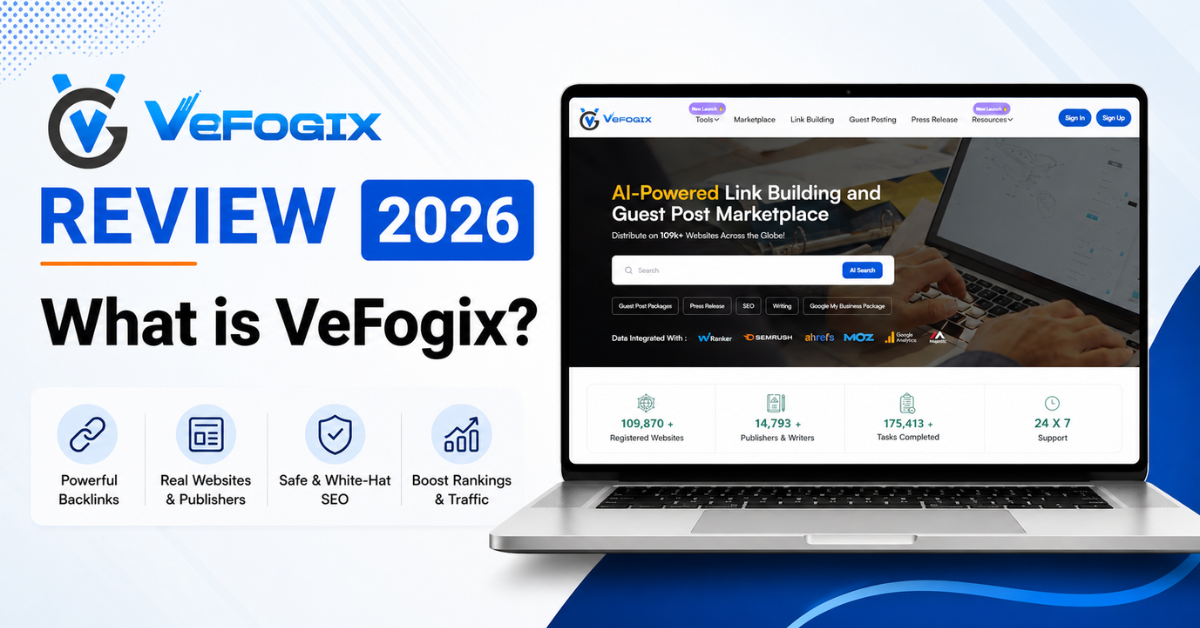
Vefogix is a link building and guest posting platform. Per its own site, it runs a network of 109,000+ websites and 14,786+ publishers and writers, spanning 80+ niches across 100+ countries. Pricing starts around $6 a placement and climbs fast from there depending on authority and niche. It runs on a pre-funded wallet — you load money in, then spend down from that balance per order — rather than charging your card placement by placement.
You can self-serve through the catalog, or hand a brief to their team and let them pick sites and write content for you. Most agencies end up doing some mix of both.
The Standout Feature: It Actually Shows You the Data
Here's the thing that's genuinely different, not just marketing language for "trust us."
Most catalogs show you one number — usually Domain Authority, because it's the easiest to inflate and the easiest for a buyer to misread. Vefogix puts DR (Ahrefs), DA (Moz), and Authority Score (Semrush) on the same listing, next to actual traffic and the number of completed orders on that domain.
That sounds like a small thing until you've been burned by a site with a DA of 60 that turns out to have a DR of 12 and traffic that wouldn't fill a coffee shop. Cross-referencing three tools manually for every prospective site is exactly the kind of busywork that makes people skip vetting entirely and just buy whatever looks good. Having it side by side doesn't replace judgment, but it removes the excuse not to use it.
The Reality Check
None of this makes the work of choosing good sites optional.
A 109,000-site network — whatever the real number turns out to be — is not 109,000 sites that are good for your niche. It's a large pool you still have to filter hard. The metrics on display make that filtering faster, not automatic. If you treat "verified" as a synonym for "premium," you'll waste money here exactly like you would anywhere else.
And the bigger thing worth saying plainly: paid link placement for SEO purposes sits outside Google's guidelines, regardless of which platform you use or how clean its verification process looks. Nothing about a polished dashboard changes that exposure. Anyone using this as their whole strategy instead of one input into a broader, mostly organic approach is taking on more risk than the UI suggests.
Feature Breakdown
Dashboard and ordering. Four steps: filter the catalog, pick a site, supply or request content, track status. It's functional. It's also a lot on first login — tens of thousands of listings and several service categories (guest posts, link insertions, press releases, GMB packages, SEO reseller tools) stacked into one interface. Filters cut the noise once you know what you're filtering for; that's a real learning curve for someone in their first week, not a dealbreaker.
The wallet. You pre-load funds rather than paying per transaction. It's not a bad system, but it does mean committing budget before you've necessarily decided exactly what you're spending it on — size your deposits to your actual order plan, not the other way around.
White-label and agency tools. This is where it stops being "a catalog" and starts being infrastructure. Agencies can run guest posting and link placement under their own brand using Vefogix's backend, with reporting built for client-facing use. Paired with backlink monitoring — tracking whether placed links stay live after publication, which most marketplaces simply don't bother doing — this is the part built for someone running ongoing campaigns, not a one-off purchase.
Support. Live chat, WhatsApp, and scheduled calls, available 24/7 according to the company. Vefogix's site also cites third-party ratings around 4/5 on Trustpilot and 4.5/5 on Clutch as of mid-2026 — worth checking those review platforms directly if that factors into your decision, since they update over time.
What's Good
- Multi-source metrics (Ahrefs, Moz, Semrush) on the same listing — real time saved on manual cross-checking
- White-label and reporting tools that make sense for agency use, not just solo buyers
- Backlink monitoring after placement, which a lot of competitors skip entirely
- Low entry price point, scaling predictably with site authority
- 24/7 support across multiple channels, per the company
What Isn't
- Pre-funded wallet adds a step most marketplaces don't require
- Dashboard density is real for first-time users — plan to spend time in the filters before buying
- Network size claims and reputation scores come from the company's own site; independently verify anything load-bearing for your decision
- A large catalog still requires real vetting work; it does not do the thinking for you
- Inherits the same compliance risk as any paid-link strategy, regardless of how it's marketed
Who This Is For
Good fit: agencies that want a white-label backend for client link building, and SEOs who already know how to read DR/DA/traffic data and just want it consolidated in one place instead of scattered across four tabs.
Bad fit: anyone who wants a single cheap link with zero interest in vetting, and anyone expecting "verified network" to mean "no due diligence required." That's not what this is, no matter how the homepage reads.
Rating
Metric Transparency █████████░ 9/10
Agency/White-Label Tools ████████░░ 8/10
Ease of Use (Day One) ██████░░░░ 6/10
Pricing Clarity ████████░░ 8/10
Support ████████░░ 8/10 *(per company-reported data)
Post-Placement Tracking ████████░░ 8/10
─────────────────────────────────────────
Overall ████████░░ 7.7/10
The Bottom Line
Vefogix solves a real, specific problem — it gives you enough cross-referenced data to actually vet a site instead of guessing — and it builds a genuine agency offering on top of a self-serve catalog instead of picking one lane. The wallet model and first-login density are minor friction, not reasons to avoid it. The bigger thing to sit with isn't about Vefogix specifically — it's that paid link building of any kind carries real risk under current search guidelines, and no platform's verification process removes that.
If you're comparing this against the rest of the field, the wider roundup at WebLinkBuzz's top link building marketplaces is a useful next stop before you commit budget anywhere.
FAQ
Is Vefogix legitimate?
It operates as a real platform with a working catalog, managed services, and published support channels. Network size and review-platform scores are company-reported; check Trustpilot and Clutch directly for current figures before relying on them.
How much does Vefogix cost?
Placements start around $6 and rise based on site authority, traffic, and niche, per pricing shown in the catalog. The wallet model means you fund a balance up front rather than paying per order.
Does Vefogix write content, or do I need to supply my own?
Both are options. You can submit your own article or request one through the managed service during checkout.
Is buying links through Vefogix safe for SEO?
Paid link placement, on any platform, falls outside Google's guidelines. Vefogix's verification process may reduce some quality risk, but it doesn't remove the underlying compliance risk of buying links for ranking purposes.
Is Vefogix good for agencies specifically?
The white-label and reporting tools are built with agency use in mind — branded delivery and client-facing reporting are real differentiators here versus a bare self-serve marketplace.
How does Vefogix compare to a standard link marketplace?
The main difference is the combination of multi-source metrics on every listing plus a managed/white-label layer on top — most marketplaces offer one or the other, not both.