
Site added
If you regularly buy guest posts or backlinks, you may have noticed something frustrating: the same website can be listed at very different prices across different marketplaces.
A publisher might cost $80 on one platform and $150 on another. The domain is the same. The difference may come from marketplace pricing, seller margins, content services, turnaround times, or the terms included with the placement.
That makes one question increasingly important:
Are you actually getting a fair price for the backlink you're buying?
This is where backlink price comparison tools can help.
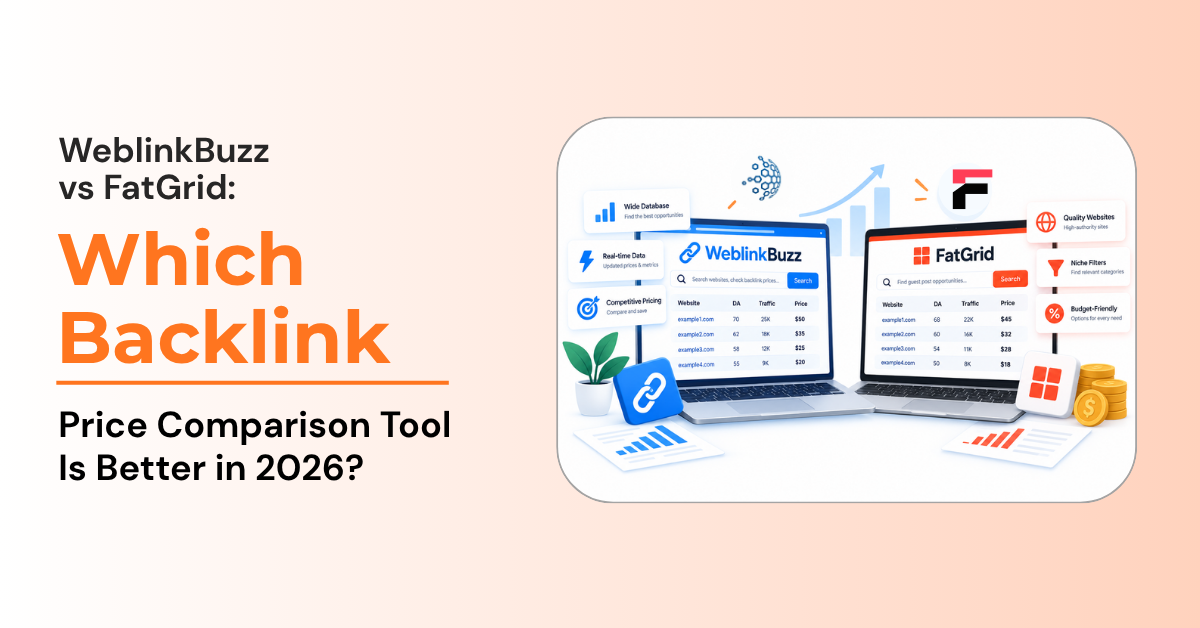
Two platforms worth considering in 2026 are WeblinkBuzz and FatGrid. Both help users compare publisher pricing, but they take slightly different approaches.
WeblinkBuzz is more focused on backlink price discovery and cross-marketplace comparison, while FatGrid combines price comparison with a broader set of link-building research and monitoring features.
So, which one is better?
The answer depends on whether you primarily want to compare backlink prices or need a broader platform for managing different parts of your link-building workflow.
WeblinkBuzz vs FatGrid at a Glance
|
Feature |
WeblinkBuzz |
FatGrid |
|
Backlink price comparison |
Yes |
Yes |
|
Guest post price comparison |
Yes |
Yes |
|
Cross-marketplace comparison |
25+ marketplaces |
15+ marketplaces |
|
Domain inventory |
663K+ domains |
330K+ publishers publicly stated |
|
Bulk domain checking |
Yes |
Yes |
|
CSV workflow |
Yes |
Yes |
|
DR / DA metrics |
Yes |
Yes |
|
Organic traffic |
Yes |
Yes |
|
Referring domains |
Yes |
Available through publisher data |
|
Price filtering |
Yes |
Yes |
|
Niche/category filtering |
Yes |
Yes |
|
Competitor backlink research |
Yes |
Yes |
|
Backlink monitoring |
— |
Yes |
|
Google search discovery |
— |
Yes |
|
AI search discovery |
— |
Yes |
|
API |
— |
Yes, on paid plans |
|
Free price checking |
Yes |
Limited free tier |
|
Main focus |
Price comparison |
Link-building research platform |
The important distinction is that these platforms are not exact substitutes.
WeblinkBuzz is more specialized around price comparison. FatGrid is broader.
That difference should guide your choice.
What Is a Backlink Price Comparison Tool?
A backlink price comparison tool helps you determine how much a publisher is being offered for across different marketplaces.
Instead of manually searching multiple platforms, you can search for a domain and compare available pricing in one place.
A useful comparison should go beyond price.
You ideally want to see information such as:
-
Domain Rating (DR)
-
Domain Authority (DA)
-
Organic traffic
-
Referring domains
-
Spam indicators
-
Niche or category
-
Link type
-
Publisher price
-
Marketplace
-
Price differences between listings
This matters because the cheapest backlink isn't necessarily the best backlink.
For example, a $70 placement on a website with declining traffic and little topical relevance may be a worse investment than a $120 placement on a relevant site with healthy organic traffic.
The goal isn't simply to find the lowest number.
The goal is to understand whether the price makes sense for the quality of the placement.
Why Compare Backlink Prices Across Marketplaces?
The backlink market doesn't have a universal pricing system.
Publishers can appear on multiple marketplaces, and each marketplace may apply different pricing structures.
The final price can be influenced by:
-
Marketplace commissions
-
Seller margins
-
Content writing
-
Editorial services
-
Turnaround time
-
Link placement requirements
-
Number of links included
-
Link duration
-
Publishing terms
-
Geographic targeting
-
Niche demand
As a result, the same domain can have significantly different prices.
That's why checking only one marketplace can give you an incomplete picture.
A backlink price comparison tool provides another layer of market intelligence before you spend your budget.
WeblinkBuzz vs FatGrid: Where They Differ
The biggest difference isn't simply the number of features.
It's the purpose behind the platforms.
WeblinkBuzz: Focused on Backlink Price Intelligence
WeblinkBuzz is built around a straightforward problem:
How much should I actually pay for this backlink?
Its backlink price checker allows users to search domains and compare pricing across multiple marketplaces.
The platform currently states that it covers 25+ marketplaces and more than 663K domains.
Users can also evaluate pricing alongside SEO-related metrics rather than looking at the price in isolation.
This makes WeblinkBuzz particularly useful when your workflow starts with a publisher you've already found and you want to validate its price before purchasing.
Useful WeblinkBuzz capabilities include:
-
Single-domain price checking
-
Bulk domain checking
-
Marketplace price comparison
-
DR and DA information
-
Organic traffic data
-
Referring domain information
-
Spam score
-
Niche/category information
-
CSV-based workflows
-
Competitor backlink research
You can start with the WeblinkBuzz Backlink Price Checker when you want to compare what a domain is being offered for across marketplaces.
FatGrid: A Broader Link-Building Platform
FatGrid approaches the problem from a wider perspective.
Its Publisher Price Finder also allows users to compare publisher prices, but the platform goes beyond price comparison.
Depending on the plan, FatGrid includes functionality for:
-
Publisher discovery
-
Competitor backlink research
-
Backlink monitoring
-
Google search discovery
-
AI search discovery
-
Keyword matching
-
CSV/Google Sheets workflows
-
API access
That makes FatGrid useful for teams that want multiple link-building research functions inside one platform.
In other words:
WeblinkBuzz is more price-comparison focused.
FatGrid is more of an all-in-one link-building research platform.
Neither approach is inherently better. They simply solve slightly different problems.
1. Marketplace Coverage
Marketplace coverage matters because the purpose of comparison is to see whether another marketplace has a better offer.
WeblinkBuzz currently states that its database covers 25+ marketplaces.
That includes marketplaces such as:
-
Adsy
-
Collaborator
-
PRNEWS.IO
-
Vefogix
-
Serpzilla
-
and other publisher marketplaces
FatGrid currently states that it covers 15+ marketplaces.
If your primary requirement is finding more marketplace listings for the same domain, WeblinkBuzz has an advantage based on the currently published marketplace counts.
However, marketplace quantity shouldn't be treated as a quality score by itself.
A smaller database can still be useful if it contains the publishers relevant to your campaign.
Verdict: WeblinkBuzz has the edge for marketplace breadth.
2. Bulk Backlink Price Checking
Bulk checking becomes important when you're working with large publisher lists.
Checking one website manually is easy.
Checking 50, 100, or 500 websites individually is not.
For agencies and experienced SEOs, a bulk workflow can save considerable time.
WeblinkBuzz
WeblinkBuzz supports bulk domain research, allowing users to work with multiple domains rather than checking each publisher individually. You can search up to 100 domains in a search.
This can be useful for:
-
Agency publisher lists
-
Guest post campaigns
-
Client backlink research
-
Publisher audits
-
Vendor price comparisons
-
Large-scale link procurement
You can also work with CSV files, making the workflow easier when publisher data is already stored in a spreadsheet.
FatGrid
FatGrid also supports bulk publisher price research and provides export functionality on its paid plans.
Verdict: Tie. Both platforms are capable here. The better choice depends on which interface and broader workflow fit your process.
3. SEO Metrics and Publisher Quality
Price alone doesn't tell you whether a backlink is worth buying.
This is one area where WeblinkBuzz's approach is useful because pricing can be viewed alongside publisher metrics.
WeblinkBuzz provides information such as:
-
DR
-
DA
-
Organic traffic
-
Referring domains
-
Spam score
-
Niche/category
This allows you to ask a better question:
Is this price reasonable for this particular website?
FatGrid also provides publisher metrics and filtering options, including authority, traffic, category, country, language and other publisher attributes.
Its broader discovery functionality can be useful when you don't already have a publisher in mind.
Verdict: WeblinkBuzz is strong for price + core SEO metric evaluation. FatGrid is stronger for advanced publisher discovery and filtering.
4. Competitor Backlink Research
Price comparison isn't the only way to discover link opportunities.
Another useful approach is to look at where competitors are already getting backlinks.
WeblinkBuzz also provides a competitor backlink analysis tool that can help identify competitor backlinks that may be available through its publisher database.
This changes the workflow from:
"How much does this website cost?"
to:
"Which websites are competitors using, and what would it cost me to obtain a similar placement?"
FatGrid also offers competitor backlink discovery as part of its broader platform.
Verdict: Tie for core competitor research. FatGrid has the advantage if competitor research needs to connect directly with its other monitoring and discovery features.
5. Backlink Monitoring
This is an area where FatGrid has a clear advantage.
FatGrid offers backlink monitoring functionality that can help users track whether acquired placements remain active and whether important link attributes change.
That can be useful for agencies managing a large number of purchased placements.
WeblinkBuzz's primary focus is different.
Its core value is helping you evaluate the opportunity and price before purchase, rather than acting as a complete backlink monitoring system.
Verdict: FatGrid.
6. Google and AI Search Discovery
Another area where FatGrid goes beyond price comparison is publisher discovery through search.
Its platform includes tools designed to find publishers through Google and AI-oriented search workflows.
This is useful when you don't already have a publisher list and instead want to discover websites that are relevant to a particular topic or keyword.
WeblinkBuzz is more focused on what happens after you've identified potential publishers:
What does the placement cost, and is that price reasonable?
Verdict: FatGrid.
7. Pricing and Accessibility
Pricing is one of the most practical differences.
WeblinkBuzz currently offers its core backlink price checking functionality for free, with broader access available through account-based features.
FatGrid has a free tier, while its paid plans provide greater access to marketplaces, usage limits and advanced functionality.
Its currently published pricing includes:
-
Start: $0
-
Pro: $34/month
-
Advanced: $199/month
The right choice therefore depends on how much of the broader platform you actually need.
If you only want to answer "Is this backlink overpriced?" a dedicated price comparison workflow may be sufficient.
If you want price comparison, competitor research, monitoring, discovery and API functionality in one platform, paying for a broader tool may make more sense.
Verdict: WeblinkBuzz has the advantage for users primarily looking for free price comparison. FatGrid makes more sense for teams that will use its broader paid functionality.
8. Which Tool Is Better for SEO Agencies?
There isn't a universal answer. It depends on the agency's workflow.
Choose WeblinkBuzz if your workflow looks like this:
Find publisher → Check price → Compare marketplaces → Evaluate metrics → Decide
WeblinkBuzz is particularly useful when your agency already has publisher prospects and needs a faster way to validate pricing.
For example, suppose a client wants 30 guest posts. You receive a publisher list from a vendor. Instead of accepting the quoted prices immediately, you can check the domains, compare marketplace prices and identify potential price differences. That gives you more information before approving the campaign budget.
Choose FatGrid if your workflow looks like this:
Discover publishers → Analyze competitors → Compare prices → Build campaigns → Monitor links
The broader functionality becomes more valuable as your agency's workflow becomes more complex.
9. Which Tool Is Better for Freelancers and Individual SEOs?
For freelancers, consultants and small SEO teams, simplicity can matter more than the number of features.
If you already have access to tools such as Ahrefs or Semrush for backlink analysis, you may not need another platform that duplicates those capabilities.
Instead, you may simply want a way to answer:
"Is this publisher's guest post price competitive?"
That's where WeblinkBuzz fits particularly well.
You can use a backlink price checker to validate the price and then use your existing SEO tools to perform deeper analysis.
This creates a relatively simple workflow without requiring another large monthly subscription.
10. Don't Choose a Backlink Based on Price Alone
This is perhaps the most important takeaway from the entire comparison.
A backlink price comparison tool should help you evaluate price, not tell you which link to buy.
Consider three hypothetical publishers:
|
Publisher |
DR |
Organic Traffic |
Price |
|
Site A |
42 |
18K |
$95 |
|
Site B |
55 |
2.1K |
$80 |
|
Site C |
38 |
25K |
$130 |
If you sort only by price, Site B wins.
But Site B may not be the best opportunity.
Site A has a combination of:
-
Reasonable authority
-
Stronger organic traffic
-
Lower price than Site C
Site C has the strongest traffic but costs more.
The right choice depends on your goals and the relevance of each website.
A better decision framework is:
Value = Quality + Relevance ÷ Price
This isn't an SEO ranking formula. It's simply a reminder that price should be considered alongside quality and relevance.
What Should You Check Before Buying a Guest Post?
Regardless of which comparison tool you use, review the publisher carefully.
1. Topical Relevance
A backlink from a website covering your industry is generally more meaningful than an unrelated placement.
2. Organic Traffic
Look at whether the website has genuine search visibility and whether its traffic appears stable.
3. Authority
DR, DA and other authority metrics can provide useful context, but they shouldn't be the only deciding factor.
4. Referring Domains
Check the site's backlink profile rather than relying on a single authority score.
5. Traffic Trends
A website with a high historical traffic number but a significant decline deserves additional investigation.
6. Content Quality
Look at the actual articles. Are they useful? Are they written for readers? Or are they hundreds of thin guest posts created mainly to sell links?
7. Link Placement
Understand whether your link will appear naturally within editorial content or in a clearly commercial placement.
8. Link Terms
Check:
-
Dofollow/nofollow
-
Link duration
-
Number of links
-
Anchor text rules
-
Content requirements
-
Replacement/refund policies
9. Marketplace Price
Finally, compare the publisher's quoted price against other available marketplace listings.
That's where a backlink price comparison tool becomes particularly useful.
WeblinkBuzz vs FatGrid: Final Verdict
So, which backlink price comparison tool is better in 2026?
WeblinkBuzz is the better fit if you primarily want:
-
Backlink price comparison
-
Guest post price checking
-
Cross-marketplace pricing
-
Bulk domain checking
-
SEO metric comparison
-
Simple publisher price research
-
A free starting point for price validation
FatGrid is the better fit if you need:
-
Backlink price comparison
-
Competitor backlink discovery
-
Publisher discovery
-
Backlink monitoring
-
Google search scanning
-
AI search scanning
-
API access
-
Broader link-building workflows
The distinction can be summarized simply:
WeblinkBuzz is more focused on understanding backlink prices. FatGrid is broader and covers more of the link-building workflow.
If you're primarily trying to determine whether a publisher's price is reasonable, WeblinkBuzz is the more focused option.
If you're looking for an all-in-one platform that combines price comparison with discovery, monitoring and other link-building capabilities, FatGrid may be a better fit.
Neither tool eliminates the need for human judgment.
And that's important.
A backlink isn't valuable simply because it's cheap.
The best purchase is usually the one where the price, relevance, publisher quality and expected SEO value make sense together.
Final Takeaway
The backlink market doesn't have one fixed price.
The same publisher can be offered at different prices depending on where you find it.
That's why price comparison should be part of your link-building due diligence.
WeblinkBuzz and FatGrid both make that process easier, but they approach it differently.
WeblinkBuzz focuses more directly on backlink price intelligence and cross-marketplace comparison.
FatGrid combines price comparison with a broader link-building research platform.
If you only remember one thing, make it this:
Don't ask, "What's the cheapest backlink?"
Ask, "What's the fairest price for a relevant, quality backlink?"
That small change in how you evaluate links can make a much bigger difference to your link-building budget.
Compare the price. Check the metrics. Evaluate the relevance. Then decide.