
Site added
Two pages can cover the same topic in almost the same words, and one still sits on page one while the other is buried on page three. In competitive niches, the gap rarely comes from the copy. It comes from who else on the web has vouched for the page.
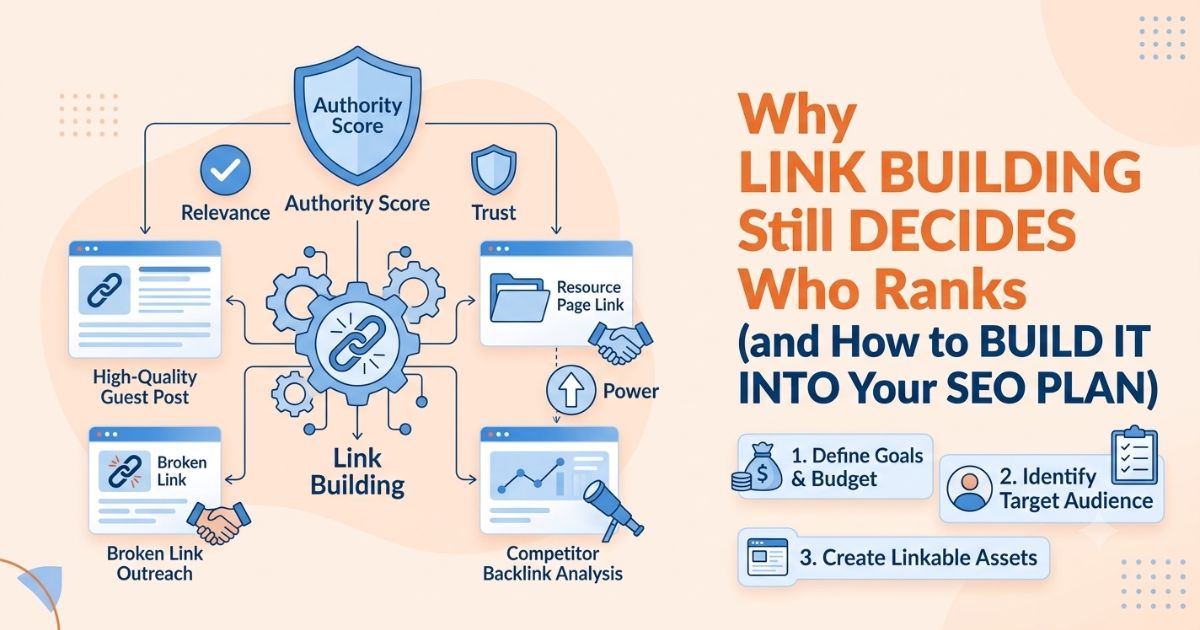
Link building is the practice of earning or placing links from other websites to your own, so that search engines and readers have independent evidence your content deserves trust. Content gets you into the contest. Links often decide who wins it.
This guide covers why links still carry weight in the age of AI search, how to judge which ones are worth having, and how to turn them into a repeatable part of your SEO plan.
Quick answer: Backlinks still matter because they are third-party evidence of trust. A search engine can analyze everything on your page, but it cannot confirm your credibility from the page alone. Links from relevant, credible sites fill that gap, which is why they continue to influence rankings, crawling, referral traffic, and brand visibility.
Why Links Still Separate Winners From Everyone Else
Plenty of sites publish well-written, well-structured content. When many pages meet the quality bar, search engines need another way to decide which one to trust. External links supply it.
Links work as proof of trust
Each link from a relevant site is a small editorial decision: someone chose to point their readers at you. A page that collects those decisions from credible sources has a stronger case than one that only claims authority about itself.
Linked pages get discovered sooner
Crawlers follow links. A new page that is linked from an established site is easier to find and tends to be crawled earlier than one that sits unlinked and waits for a sitemap visit.
Referral traffic arrives with intent
A link inside a relevant article sends readers who are already interested in the topic. Even when the ranking effect takes time, that traffic can start converting right away.
Good links keep paying off
A paid ad stops the moment the budget does. A link placed in a lasting, relevant article keeps sending signals and visitors for as long as that page stays live.
How Links Feed AI Search and Entity Trust
AI answer engines such as Google’s AI Overviews, ChatGPT search, and Perplexity do not answer from memory alone. Most of them use retrieval-augmented generation (RAG): the system first retrieves relevant documents from a web index, then writes an answer grounded in what it found. Links matter at both stages.
• Retrieval: The web index these systems draw on is built on crawling and ranking, and the link graph is one of the signals that decides which pages look trustworthy enough to surface. A well-linked page is more likely to be retrieved at all.
• Entity validation: When authoritative publications in your niche mention and link to your brand alongside a topic, they reinforce the association between your brand (the entity) and that subject. Consistent, independent mentions give a system more reason to treat you as a credible source to cite.
• Grounding: Answers are built from retrieved pages, so the pages that earn citations tend to be clear, specific, and corroborated elsewhere on the web.
The platforms do not publish how heavily they weigh any of these signals, so no one can promise a citation. What you can control is the evidence: earn links and mentions from relevant, credible publications, describe your brand consistently across them, and point those links at the pages that answer the questions you want to be known for.
Choose Links by Relevance, Not Just DR
Domain Rating (DR) is a third-party metric. It is not a Google score, and it can be inflated by link patterns that do not reflect real audience or editorial quality. Treat it as a first filter, then check the signals below before you pursue or buy a placement.
|
Signal |
What to check |
Red flag |
|
Topical relevance |
The site regularly publishes on your industry or a closely related one. |
Content spans casinos, crypto, recipes, and software on the same domain. |
|
Organic traffic |
Steady or growing search traffic that matches the site’s topics. Check the trend over the past year, including any drop after a core update, and always read it alongside DR. |
High DR with little or no organic traffic, or a sharp drop that has not recovered since a core update. |
|
Editorial standards |
Real authors, original writing, and a clear editorial process. |
Thin posts, generic stock copy, or "write for us" pages promising any link. |
|
Outbound links |
Few outbound links per article, mostly to relevant sources. |
Dozens of commercial links to unrelated sites on a single page. |
|
Placement |
Link sits inside the body of the article, in context. |
Footer, sidebar, author-bio-only, or a page buried deep in the site. |
|
Indexed status |
New articles on the domain appear in Google soon after publishing. Search the exact title of a recent post, and use a site: query to confirm the section you would be placed in is indexed. |
Recent posts missing from results, or large parts of the site not indexed. A link on an unindexed page passes little value. |
|
Site history |
A clean, consistent publishing history and a visible audience. |
Signs of past spam, expired-domain reuse, or sudden topic changes. |
Link Building Methods Compared
No single tactic should carry your whole profile. Each one suits a different goal, and mixing them keeps the profile looking natural and less fragile.
|
Tactic |
Works best for |
Effort |
Main risk |
|
Guest posts |
Topical authority in a specific niche |
Medium |
Low-quality sites that sell placements to anyone |
|
Digital PR |
Brand visibility and high-authority coverage |
High |
Coverage is unpredictable |
|
Linkable assets |
Original data, tools, templates, and in-depth guides |
High upfront |
Slow to gain traction without promotion |
|
Resource-page outreach |
Evergreen guides and reference content |
Medium |
Low reply rates |
|
Unlinked brand mentions |
Brands that are already being talked about |
Low |
Limited volume |
|
Partnerships |
Co-created content and joint studies |
Medium |
Reciprocal-link patterns if overused |
Why digital PR deserves its own line in the plan
Digital PR earns brand mentions and tier-1 publication coverage that cannot be bought on a marketplace. Those placements come from journalists and editors choosing to cover you, which makes them the strongest editorial endorsement on this list and gives digital PR a value guest posting cannot match. It is slower and less predictable, so treat it as the foundation of brand authority and use other tactics to fill the gaps around it.
A note on outreach response rates. Cold outreach to strangers usually earns few replies, so expect to send many personalized pitches for each link. Partner outreach to contacts you already work with, such as customers, suppliers, and co-authors, tends to get a far better response because there is an existing relationship. Build a warm-contact list first and use cold outreach to fill the gaps.
Editorial Links vs Sponsored Placements
Keep the two categories separate in your plan, because search engines and readers treat them differently.
• Editorial links are given without payment because the content earned them: a journalist cites your data, a blogger references your guide, a resource page lists your tool.
• Sponsored or commercial placements involve payment or another exchange of value, whether you pay an editor directly or buy through a marketplace.
If an editor or marketplace requires payment, treat the link as sponsored. Google’s spam policies classify buying links to pass ranking credit as a violation, and its guidance expects paid links to carry rel="sponsored" (or rel="nofollow"). Do not ask a publisher to remove those attributes.
Buy for audience, not for PageRank. The safest reason to purchase a placement is the referral traffic it can send: the quality of the readers, how well the article matches your topic, and the chance they convert. Any ranking benefit is a bonus you should not count on. Keep sponsored placements in proportion to the editorial links you earn.
Keep Anchor Text and Pace Natural
Two habits cause more trouble than almost any others: over-optimized anchors and unnatural bursts of links.
• Anchor text: Make most anchors branded, naked URLs (the bare address), or generic phrases such as "source," "website," or "read more," alongside descriptive anchors that name the page. Use partial-match anchors in moderation and exact-match anchors sparingly. A profile where most links repeat the same commercial phrase looks engineered.
• Pace: Steady, consistent acquisition beats sudden spikes. Match your link rate to your site’s age, size, and content output.
Compare Guest Post Prices Before You Commit
The same domain can be listed at very different prices on different marketplaces. If you accept the first quote, you may pay noticeably more for an identical placement, or you may pay for a site whose metrics do not justify the price.
Checking each marketplace by hand is the friction point. A link building tool such as WeblinkBuzz removes it: its Guest Post Price Comparison Tool lets you compare guest post prices for a domain side by side, next to DR, organic traffic, and niche data. Running a backlink price comparison before every purchase is one of the cheapest quality checks in the whole process.
When you run a backlink cost comparison, judge the number against the site, not in isolation:
• Is the price in line with the site’s real organic traffic, not just its DR, and could the referral traffic justify the cost on its own?
• Is the site relevant enough to your niche that its audience could plausibly become your customers?
• Are the delivery terms, content rules, and link attributes clearly stated?
• Is the cheapest listing hiding a weak site, or is it a fair deal on a good one?
Working through a long prospect list? Bulk price checking lets you compare many domains in one pass instead of opening each marketplace separately.
How to Build Links Into Your SEO Plan
Treat link building as a line item in the plan, with owners, a monthly cadence, and a way to measure results.
1. Start with your money pages. List the 10 pages that matter most commercially. These are the pages where extra authority pays back fastest.
2. Run a gap check. Compare the referring domains of each page with the pages ranking above it. A competitor backlink analysis shows which domains link to your competitors but not to you.
3. Create something worth linking to. Original data, calculators, templates, and thorough guides give people a reason to cite you. Publishing alone is not enough, so promote each piece.
4. Build a filtered prospect list. Shortlist 20 to 30 relevant sites per niche using traffic, relevance, and editorial-quality filters. A link building tool speeds this up, but you still review each site by hand.
5. Mix tactics over 60 to 90 days. Combine guest posts, outreach for resource pages, digital PR, and partnerships rather than leaning on one method.
6. Track monthly. Watch rankings, new referring domains, referral traffic, and your anchor-text mix for each target page.
7. Audit quarterly. Review the profile for patterns and problems. Disavow sparingly: Google’s spam systems, including Penguin, mostly devalue spammy links automatically, so reserve the disavow file for manual actions or obvious link attacks. Note which pages and anchors are gaining authority.
Pre-Link Checklist
Run through this list before you pitch, publish, or pay for any placement.
☐ The site publishes on a topic close to mine.
☐ Organic traffic is real and consistent, not just a high DR.
☐ The link will sit inside the article body, in a natural context.
☐ The page has a reasonable number of outbound links.
☐ The anchor text fits the sentence and keeps my overall mix varied.
☐ The site has no obvious history of spam or sudden topic changes.
☐ Any paid or sponsored link is disclosed and carries rel="sponsored" or rel="nofollow".
☐ Recent articles on the site get indexed in Google.
☐ I have compared the price against other marketplaces and against the site’s metrics.
☐ Expected referral traffic or strategic keyword value justifies the acquisition cost and effort.
Common Mistakes to Avoid
• Chasing DR alone. Authority metrics are a starting point, not a verdict.
• Repeating the same anchor. Heavy use of one commercial phrase invites scrutiny.
• Buying before comparing. Skipping price and metric comparison is the easiest way to overpay.
• Building links to weak pages. Links amplify what is already there. Improve the page first.
• Measuring nothing. Without a monthly check on rankings and referring domains, you cannot tell which efforts are working.
Conclusion: Make Links a Permanent Part of the Plan
Great content earns you a place in the competition. Relevant, credible links help decide who finishes first. Choose sites by relevance and real traffic, vary your tactics and anchors, keep a steady pace, and review the profile every quarter.
When you are ready to source placements, WeblinkBuzz lets you check a domain, compare guest post prices across marketplaces, and see the SEO metrics beside each listing before you spend. Try the free price comparison on a domain you are considering.