
Site added
Your competitor didn't get to page one by accident. Somewhere in their backlink profile is a list of sites that trust them enough to link out — and if those same sites haven't linked to you yet, that's not competition. That's a gap. And gaps are the cheapest, fastest wins in link building, because someone else has already done the hard part: proving the site accepts links from businesses like yours.
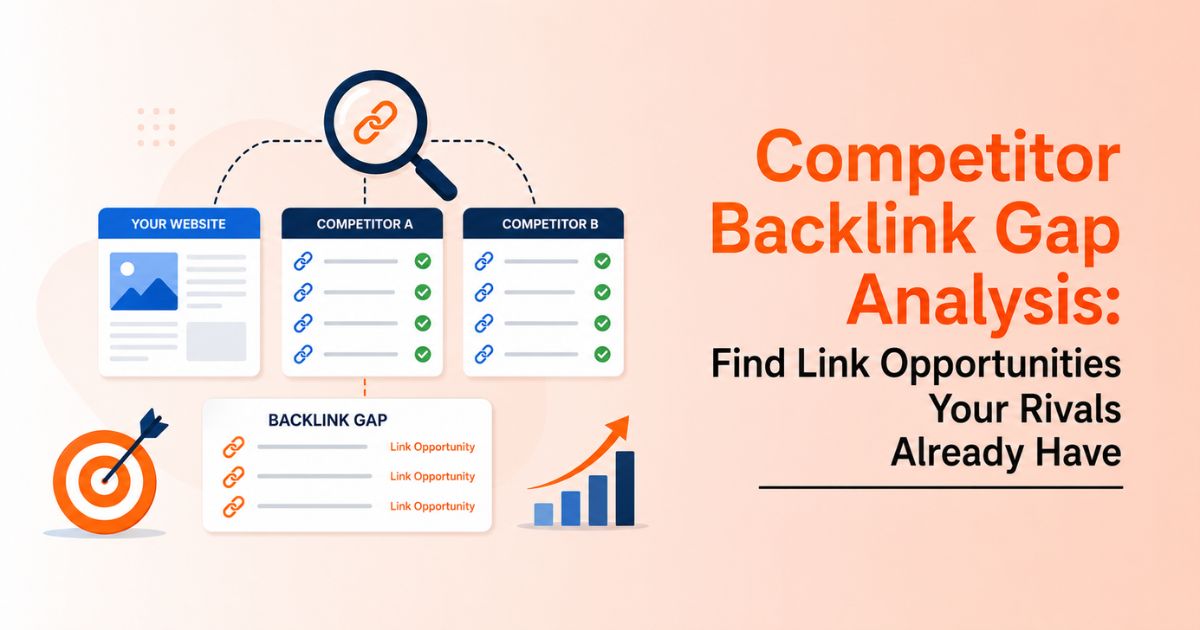
A competitor backlink gap analysis is how you find that list. This guide walks through the exact process, then shows you how to turn a spreadsheet of "who links to them" into an actual buying decision — including how to compare guest post prices before you spend a single dollar closing the gap.
What Is a Competitor Backlink Gap Analysis?
A backlink gap analysis compares the referring domains pointing to one or more competitors against your own backlink profile, then isolates the domains that link to them but not to you. Some people call this a "link intersect" — same idea, different name.
The output isn't just a list of URLs. It's a prioritized shortlist of sites that have already demonstrated three things you'd otherwise have to test blind:
-
They accept outbound links to businesses in your space
-
They rank well enough to send real traffic and pass real authority
-
They're relevant enough to your niche that a link from them makes contextual sense
That's a meaningfully shorter path than cold outreach to random prospect lists, where you're guessing at all three.
Why This Matters More in 2026 Than It Used To
Search engines have gotten sharper at discounting links that look manufactured, irrelevant, or disconnected from a site's actual topic. A gap-analysis link tends to survive that scrutiny better than a randomly sourced one, because it's already living inside a relevant content cluster next to a competitor of yours. The site's editorial team has already decided that businesses in your category belong in their content.
It also compounds. If three competitors all have a link from the same industry publication and you don't, that absence is doing quiet work against you every time a prospect compares options — both in classic rankings and in how AI-generated answers synthesize "who's trusted in this space" from citation patterns across the web.
The Backlink Gap Analysis Process, Step by Step
Step 1: Identify the Right Competitors
Pick 3–5 sites that compete with you for the same keywords or the same customer, not just companies you consider rivals in the boardroom. A backlink gap analysis against the wrong competitor set wastes effort on domains that were never going to be relevant to your audience.
Step 2: Pull Their Referring Domains
Export the full list of unique referring domains for each competitor from your SEO tool of choice (Ahrefs, Semrush, or similar). Combine the lists and remove duplicates so you're working from one master file.
Step 3: Filter for Quality and Relevance
Not every domain linking to a competitor is worth chasing. Strip out anything with negligible organic traffic, a high spam score, or no topical connection to your niche — chasing Domain Rating alone is one of the most common ways link builders waste budget. Our guide on what actually makes a backlink high-quality is worth a read before you finalise this list, and our breakdown of DR vs. traffic will help you set sensible cutoffs.
Step 4: Find Out Which Domains You Can Actually Buy a Link On
This is where most gap analyses stall. You now have a clean list of high-value domains — but you don't know which ones sell guest posts, link insertions, or sponsored placements, or through which seller. Checking each domain one by one, marketplace by marketplace, is the slow, manual version of this step.
This is exactly the problem WeblinkBuzz's bulk backlink price checker is built for. Upload your gap-analysis list — up to 20 domains at once, or a full CSV for larger batches — and it checks availability and pricing across 56+ marketplaces simultaneously, so you find out in one pass which domains from your competitor's backlink profile are actually purchasable, and through whom.
Step 5: Compare Guest Post Prices Before You Buy
Once you know a domain is available, the same domain is often listed on more than one marketplace at wildly different prices — sometimes two to five times apart for the identical placement. Buying from the first listing you see, without running it through a proper guest post price comparison tool, is how link-building budgets quietly bleed out. Run every domain on your shortlist through the WeblinkBuzz price checker first, and buy from whichever marketplace has the best combination of price and terms for that specific domain.
Step 6: Prioritize and Build Your Buying List
Rank the surviving domains by a blend of relevance, traffic, and price-to-value, not authority alone. A DR 40 site with steady, on-topic traffic at a reasonable price usually outperforms a DR 60 site with thin traffic at triple the cost.
Manual Gap Analysis vs. Using a Comparison Tool
Task |
Doing It Manually |
Using a Guest Post Price Comparison Tool |
Checking if a domain sells links |
Visit each marketplace individually, search by hand |
One bulk search returns availability across 56+ marketplaces |
Comparing prices for the same domain |
Open multiple tabs, record prices in a spreadsheet |
Prices shown side by side automatically |
Processing a list of 50+ domains |
Hours of repetitive searching |
Minutes, via CSV upload |
Spotting the cheapest legitimate source |
Easy to miss a cheaper listing on an unfamiliar marketplace |
Surfaced automatically |
Cost |
Free, but expensive in time |
Free at WeblinkBuzz |
Backlink Marketplace vs. Direct Outreach for Gap-Analysis Links
Once you know which domains from the gap are purchasable, you generally have two paths to close the gap:
Buy through a backlink marketplace. Faster, transparent pricing, and no cold outreach required — the seller has already agreed to place contextual backlinks on the domain. This is the more efficient route for most of the domains a gap analysis surfaces, since you already know the site accepts paid placements from a competitor's presence there.
Reach out directly. Slower and less certain, but sometimes necessary for domains not listed on any marketplace, or where you want more editorial control over the placement.
For domains that do show up on a marketplace, the deciding factor usually isn't whether to buy — it's where to buy from at the best price. If you're still weighing which route fits your workflow overall, our comparison of a link building marketplace vs. an agency walks through the trade-offs, and our roundup of the top 19 link building marketplaces is a useful reference if a domain from your gap list turns out to be sold through a marketplace you haven't used before.
A Practical Checklist Before You Buy Any Gap-Analysis Link
-
Confirm the domain has real, stable organic traffic — not just a high authority score
-
Check that its traffic is concentrated in your actual target geography
-
Verify it ranks for genuine keywords in your niche, not unrelated topics
-
Compare price across at least two to three marketplaces before ordering
-
Avoid domains with a rising spam score or an unnatural traffic spike or drop
-
Keep a record of every placement so you can monitor whether it stays live and indexed
If you want the fuller version of this vetting process, our guides on common link building mistakes and white hat vs. grey hat link building cover the risk side in more depth, and 10 red flags to avoid when hiring a link building service is worth a look if you're outsourcing any part of this process.
How WeblinkBuzz Fits Into This Workflow
WeblinkBuzz doesn't replace your SEO tool's backlink export — you'll still pull the raw referring-domain list from Ahrefs, Semrush, or whichever platform you use. What it handles is everything after that: turning a raw list of competitor referring domains into a ranked, priced buying list. Paste or upload your domains, see which ones are listed across 56+ marketplaces, and compare guest post prices side by side before you commit budget. For agencies running this process across several client accounts at once, the bulk upload is built specifically for that volume rather than one-off single-domain checks.