
Site added
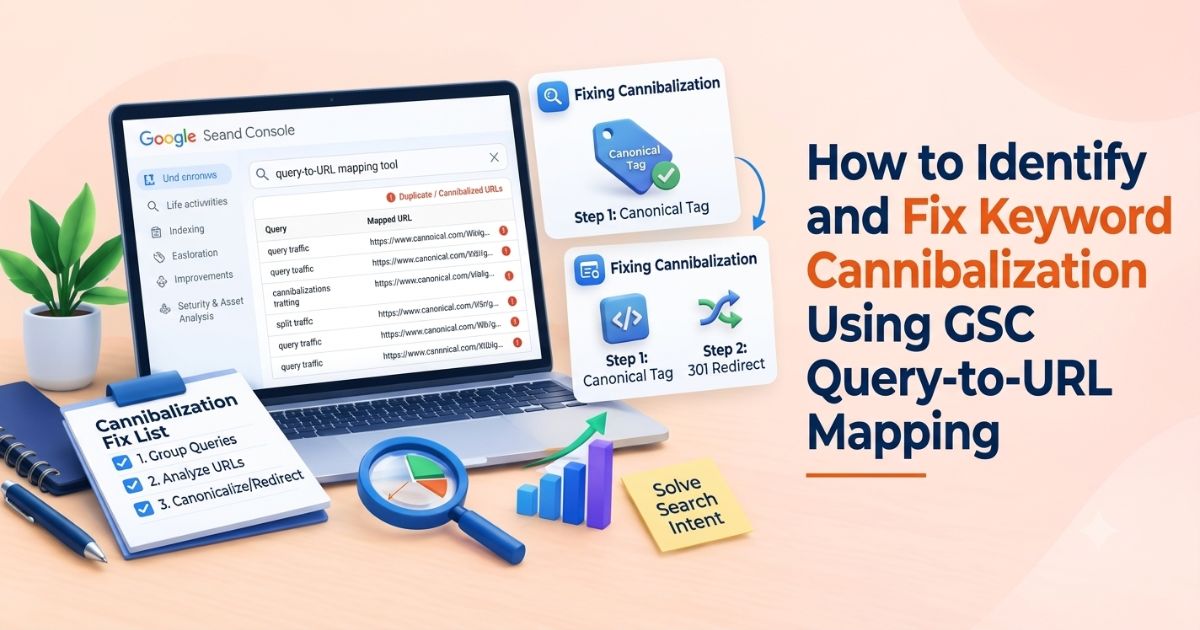
Two pages on the same site quietly competing for the same query is one of the easiest technical SEO problems to miss and one of the most expensive to leave alone. Neither page ranks as well as a single, consolidated page would, and most sites don’t notice until rankings have been flat for months. A query-to-URL map a table pairing each core search query with every URL currently earning impressions for it turns that vague suspicion into a page-by-page action list. This guide covers building that map inside Google Search Console, reading it correctly, and running a consolidate-differentiate-or-redirect decision on every page it flags.
What Keyword Cannibalization Actually Is
Keyword cannibalization happens when two or more URLs on the same domain target the same search intent, so Google splits ranking signals, clicks, impressions, and backlink equity between them instead of consolidating on one authoritative page. It is not the same as normal topical overlap. A pillar page and a subtopic post that answers a narrower question aren’t cannibalizing each other if the search intent behind each query is genuinely different — the problem only exists when two pages are answering the same query for the same reason.
Why It Costs More Than a Ranking Dip
• Backlink equity gets divided across two URLs instead of reinforcing one, so neither builds the authority it would on its own.
• Crawl budget is spent re-indexing near-duplicate pages instead of new or updated content.
• Topical authority signals get muddied; a site that looks unsure which page “owns” a topic is treated as less authoritative on that topic overall.
• Content production budget goes toward maintaining two competing pages instead of strengthening one.
Step 1: Build a Query-to-URL Map in Google Search Console
The map itself is simple: one row per core query, listing every URL that earns clicks or impressions for it, plus clicks, impressions, and average position for each. Here’s how to pull it.
1. Open Performance > Search Results and set the date range to three to six months — enough volume for the pattern to be real rather than noise.
2. On the Queries tab, sort by impressions and shortlist the core topic queries you want to map (branded queries can usually be excluded).
3. Click into an individual query. Search Console switches to a Pages view scoped to that exact query; this is the list of every URL currently earning impressions for it.
4. Record each query alongside its ranking URL(s), clicks, impressions, and position in a spreadsheet. That spreadsheet is the query-to-URL map.
5. On larger sites, narrow the pull first with a Query regex filter for the topic and, optionally, a Page regex filter for the section. Our guide on combining GSC regex filters covers that filtering mechanic if you haven’t set it up yet.
6. Flag any query where two or more URLs are earning meaningful impressions in the same window with average positions within roughly ten spots of each other; that’s your cannibalization shortlist.
Step 2: Read the Map — Three Patterns to Look For
|
Pattern |
What the Map Shows |
Typical Fix |
|
Split ranking |
Two URLs alternate top positions for the same query, week to week |
Consolidate into one URL; 301 redirect the other |
|
Shadow competition |
One URL ranks well; a second, barely-related URL sits far lower for the same query |
De-optimize or redirect the weaker page |
|
Genuine overlap |
Two URLs get impressions, but for different sub-queries within the cluster |
No fix needed confirm with distinct titles and internal links |
Step 3: Decide — Consolidate, Differentiate, or Redirect
• Same search intent, same audience → consolidate the content and 301 redirect the weaker URL to the stronger one.
• Same topic, different intent (e.g., a comparison query vs. a definitional one) differentiate- rewrite titles, H1s, and meta descriptions to target the distinct sub-queries, then link the two pages to each other.
• One URL already holds most of the backlinks: keep that URL, redirect the other into it so its link equity passes through.
• Both URLs have meaningful backlinks of their own: merge the unique content into the stronger page, then redirect the weaker one; don’t just delete it.
Step 4: The Fix Workflow
1. Pick the surviving URL the one with the stronger backlink profile and ranking history from your query-to-URL map.
2. Merge the losing page’s unique value (data, subtopics, examples) into the surviving page rather than discarding it outright.
3. 301 redirect the losing URL to the surviving URL.
4. Update internal links sitewide that still point to the old URL so they resolve directly, without an extra redirect hop.
5. Remove the old URL from the XML sitemap and submit the updated sitemap.
6. Request indexing on the surviving URL through GSC’s URL Inspection tool.
7. Watch the Performance report for that query cluster over the next four to eight weeks — a genuine consolidation shows the surviving URL’s impressions rising roughly to the combined total of both pages, not just to whichever page was already stronger.
|
💡 Agency Tip: Streamlining the Off-Page Recovery • Audit domain health: run competing URLs through a bulk backlink checker to flag toxic links before setting up 301 redirects. • Evaluate metrics at scale: use an SEO bulk domain checker to review domain authority and traffic across every replacement target simultaneously. • Compare placement costs: use an agency backlink price tool and bulk guest post price checker to source market prices for new backlinks without leaving your dashboard. |
Step 5: Rebuild the Surviving Page’s Link Authority
When you consolidate two competing URLs, it’s worth auditing the referring domains pointing to both pages first, so no toxic links get carried over during the redirect. An SEO bulk domain checker or a bulk backlink checker lets you evaluate DR, spam score, and organic traffic across every referring domain in one pass, instead of reviewing each backlink target manually.
Once that clean domain baseline is set, rebuilding the authority the merge is supposed to recover means acquiring fresh, contextual placements. An agency backlink price tool or bulk guest post price checker streamlines that step by comparing pricing across marketplaces in one search, so outreach stays on budget while the surviving URL rebuilds its authority.
WeblinkBuzz’s bulk guest post price checker runs this exact pricing side of the workflow — paste the domains, compare pricing across 21+ marketplaces in one search, and buy without leaving the tab.
Scaling the Fix Across Multiple Client Sites
If you manage multiple client accounts, fixing cannibalization across dozens of query clusters at once can turn into a research bottleneck fast. Rather than manually evaluating off-page targets for every affected page, run the domain audit and the pricing lookup as one workflow: an SEO bulk domain checker handles the technical analysis side, while a bulk guest post price checker handles vendor outreach, so off-page recovery stays efficient at agency scale.
Whichever tool handles the pricing lookup, two things still apply regardless of scale: keep anchor text pointed at the surviving URL proportional to what’s already linking there — repeating an exact-match anchor at volume reads as manipulative — and check each prospective site’s spam score and penalty history before buying. A page that’s just recovering its rankings post-consolidation is not the place to introduce a fresh link building risk.
Common Mistakes When Fixing Cannibalization
• Redirecting the stronger page into the weaker one by mistake — always confirm which URL holds more backlinks and historical traffic first.
• Deleting the losing page outright instead of merging its unique content, which throws away subtopics the surviving page never covered.
• Forgetting to update internal links, so the site keeps pointing at a redirected URL instead of the final destination.
• Making repeated redirect changes in a short window, which confuses indexing and delays recovery.
• Over-consolidating genuinely distinct content — not every query overlap is cannibalization; check search intent before merging.
The Bottom Line
A query-to-URL map replaces a vague sense that “something’s off” with a page-by-page list: consolidate, differentiate, or redirect. Once you know which URL to build behind, the research bottleneck shifts from diagnosis to pricing out the links that will rebuild its authority. WeblinkBuzz’s bulk backlink checker compares guest post pricing across 21+ marketplaces in one search, so link building can restart the same day the fix ships. Compare Backlink Prices in Bulk