
Site added
Buying backlinks one at a time may seem manageable when you're running a small SEO campaign. But once you are handling hundreds of domains, several clients, or recurring guest post campaigns, the process quickly becomes a bottleneck.
The problem isn't simply the number of backlinks you need to buy. It's the amount of research required before each purchase.
You may need to check a publisher's price, domain authority or rating, organic traffic, topical relevance, publishing requirements, and other quality signals. Then you have to compare those details with dozens or hundreds of alternatives.
That is where backlink research at scale becomes valuable. Instead of evaluating every publisher as an isolated opportunity, SEO teams can build a repeatable process for filtering domains, comparing prices, identifying potential value, and reviewing shortlisted websites.
A bulk guest post price checker can support this process by making it easier to examine publishing costs across multiple domains rather than researching every opportunity manually.
Why One-by-One Backlink Research Becomes a Problem
Manual research isn't necessarily bad. In fact, human review remains essential when evaluating backlink opportunities. The problem starts when every domain requires the same sequence of manual checks.
Imagine an agency receives a list of 500 potential publishers. For every domain, someone has to investigate publishing price, domain rating or authority, organic traffic, website niche, audience relevance, link placement conditions, content requirements, and publisher availability.
Even if each review takes only a few minutes, the total workload can become substantial. More importantly, manual research can produce inconsistent decisions. One team member may prioritize traffic, while another focuses primarily on authority or price.
A scalable system creates a consistent first layer of research while keeping human judgment for the final evaluation.
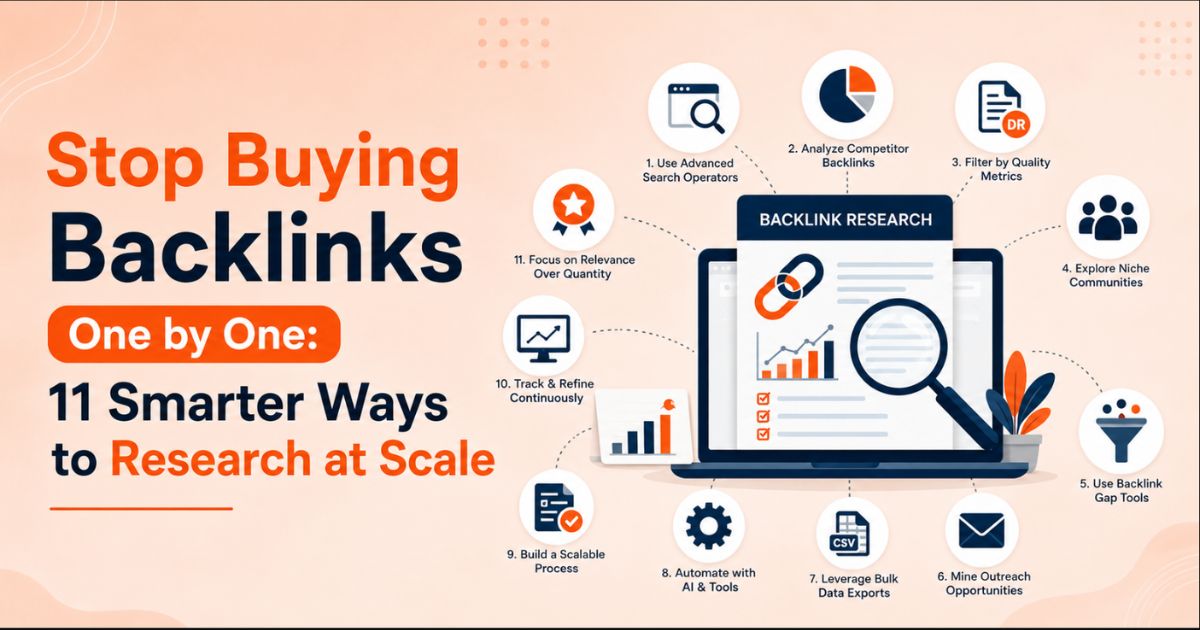
11 Smarter Ways to Research Backlinks at Scale
1. Start with bulk pricing research
The first improvement is simple: stop treating every backlink price as an individual data point. When you need to evaluate dozens or hundreds of publishers, gathering prices together gives you a much clearer view of the market.
A bulk pricing workflow allows you to identify the range of publishing costs before deciding which opportunities deserve deeper investigation.
This changes the question from “Can we afford this website?” to “How does this website's price compare with similar opportunities?” A price has little meaning without context.
2. Check multiple backlink prices before making a decision
A publisher charging $150 isn't necessarily expensive or cheap. The answer depends on what comparable websites charge and what you receive for the placement.
When you check multiple backlink prices, you can establish useful benchmarks based on niche, domain authority, organic traffic, geographic audience, content requirements, and publisher reputation.
For example, a large publisher dataset may contain thousands of records with different prices for content placements. Looking at those records collectively can reveal pricing patterns that are almost impossible to notice when researching websites individually.
The objective isn't to automatically choose the lowest price. It is to understand where an opportunity sits within the broader pricing landscape.
3. Build a bulk link price comparison process
A consistent comparison process makes backlink procurement much easier to manage. Instead of keeping scattered notes, organize your research around standard fields such as Domain, Category / Niche, DR / DA, Monthly Traffic, Content Placement Price, Currency, and Status.
|
Domain |
Category / Niche |
DR / DA |
Monthly Traffic |
Content Placement (USD) |
Status |
|
example.com |
Technology |
55 |
25,000 |
$150.00 |
Active |
|
example.org |
Marketing |
61 |
42,000 |
$175.00 |
Active |
|
example.net |
SaaS |
48 |
18,000 |
$110.00 |
Review |
Once the information is standardized, you can sort and filter opportunities according to campaign requirements.
4. Screen large domain lists before deeper analysis
Not every domain deserves the same amount of attention. Large backlink lists can contain duplicate websites, irrelevant publishers, inactive domains, very low-traffic sites, or opportunities outside the target market.
An SEO bulk domain checker can help with the initial screening stage.
The process becomes: Large domain list → Initial filtering → Qualified domains → Detailed review → Final shortlist.
The key is to use bulk screening as a filtering mechanism, not as a replacement for quality evaluation.
5. Compare publisher prices across sources
Backlink pricing isn't always consistent across marketplaces and vendors. The same domain may appear in different places with different pricing, depending on the provider, package, relationship, or service being offered.
When you compare backlink prices in bulk, you can spot large pricing differences, duplicate publishers, potentially overpriced listings, competitive offers, premium publishers, and gaps between different sources.
The purpose of comparison is to understand the options before committing your budget, not to assume the lowest listing is automatically the best option.
6. Evaluate value, not just price
One of the biggest mistakes in backlink procurement is treating price as the primary quality indicator. A cheaper placement may look attractive on a spreadsheet but provide little value if the website has poor relevance, weak traffic, or low-quality content.
|
Factor |
What to Consider |
|
Topical relevance |
Does the website fit the client's industry? |
|
Organic traffic |
Does the site appear to attract genuine search visibility? |
|
Authority |
How does its authority compare with alternatives? |
|
Content quality |
Is the existing content useful and credible? |
|
Audience |
Does the site reach the right users? |
|
Price |
Is the cost reasonable for the overall opportunity? |
|
Placement conditions |
What exactly is included in the publishing arrangement? |
This produces a much better picture of value than a price column alone.
7. Create a reusable publisher database
If your team researches backlinks repeatedly, don't throw away the research after every campaign. Build a central publisher database that records previously evaluated domains.
Useful fields can include Domain, Niche, Country, DR/DA, Organic Traffic, Content Placement Price, Last Verified Date, Vendor, Campaign Suitability, and Notes.
This means that when another client needs publishers in the same industry, your team already has a starting point. However, pricing and website metrics change, so old information should be treated as historical data.
8. Benchmark pricing by niche
A single backlink price benchmark rarely works across every industry. Publishing opportunities in technology, finance, SaaS, legal, healthcare, marketing, and other industries can have very different market conditions.
Instead of asking, “What is a normal guest post price?” ask, “What is a reasonable price for this type of publisher in this niche and quality range?”
This is where bulk domain guest post pricing data becomes useful. By grouping publishers according to niche, authority, traffic, or other attributes, agencies can develop more meaningful benchmarks.
9. Identify pricing outliers
Large datasets become particularly useful when you're looking for unusual values. Suppose a group of websites with broadly similar authority and traffic falls within a particular pricing range, while one publisher is dramatically more expensive.
That doesn't mean the expensive publisher is automatically a poor choice. The difference may be explained by strong brand recognition, a highly relevant audience, exceptional editorial standards, a high-demand niche, limited publisher availability, or additional services.
Instead of asking only whether the price is good, ask why the price is different.
10. Monitor backlinks after acquisition
Backlink research shouldn't stop when an order is placed. Large campaigns also require ongoing monitoring.
A bulk backlink checker can help teams review multiple acquired links and identify potential changes, such as a page becoming unavailable, a link being removed, a domain going offline, a target URL changing, link attributes changing, or previously active placements becoming inaccessible.
Checking 10 backlinks manually is relatively easy. Checking hundreds or thousands repeatedly is not.
11. Use a comparison-first platform such as WeblinkBuzz
The biggest advantage of working with large backlink datasets is not simply having more data. It is being able to turn that data into useful comparisons.
This is where WeblinkBuzz fits into the workflow. Instead of moving between individual publisher websites, spreadsheets, and different marketplace listings, marketers can approach the research process from a comparison-first perspective.
Traditional workflow: Find publisher → Visit source → Check price → Record metrics → Repeat → Compare spreadsheet → Recheck information
Comparison-first workflow: Collect opportunities → Compare publisher information → Filter by requirements → Evaluate shortlisted domains → Verify → Select
WeblinkBuzz can be particularly useful for teams that need to compare guest post opportunities using publishing prices and website metrics before deciding which domains deserve closer attention.
The platform shouldn't replace human judgment. Instead, it can help reduce the repetitive research involved in getting to the shortlist.
How to Build a Scalable Backlink Research Workflow
You don't need to automate every part of your SEO process. A practical workflow can combine bulk research with manual quality control.
Step 1: Collect relevant domains — Start with publishers potentially relevant to the client's industry, audience, and geographic requirements.
Step 2: Screen the list — Remove obvious mismatches, duplicate domains, inactive opportunities, and publishers that don't meet basic requirements.
Step 3: Gather pricing information — Collect current publishing costs so opportunities can be compared using the same framework.
Step 4: Add SEO context — Combine pricing with authority, organic traffic, niche, audience, and other available metrics.
Step 5: Create a shortlist — Prioritize opportunities offering a reasonable combination of relevance, quality, and cost.
Step 6: Conduct manual review — Inspect shortlisted websites rather than relying entirely on automated metrics.
Step 7: Track acquired placements — Maintain a record of purchased links and periodically check whether placements remain active.
What Should Agencies Look for in a Backlink Research Tool?
The number of domains a tool can process is only one consideration. For an agency, useful capabilities include bulk domain research, pricing comparison, website authority metrics, traffic information, niche or category filtering, sorting and filtering, export options, publisher comparison, pricing updates, and backlink monitoring.
An agency backlink price tool should ultimately help the team make decisions faster without sacrificing quality control.
The ideal workflow isn't “automate everything.” It is: Automate repetitive research → Filter opportunities → Apply human judgment → Make the final decision.
Common Mistakes When Scaling Backlink Research
Choosing backlinks based only on price
A low price can be attractive, but cost without quality context tells you very little.
Treating DR or DA as the complete picture
Authority metrics are useful comparison signals, but they don't tell you everything about a website.
Ignoring topical relevance
A high-authority domain can still be a poor fit if its audience and content have little connection to the target website.
Using outdated pricing
Publisher prices can change. Always verify important pricing information before placing an order.
Assuming bulk tools replace human review
Bulk analysis is excellent for narrowing a large dataset. It shouldn't eliminate the final quality check.
Using one benchmark for every client
Different industries, audiences, countries, and campaign objectives require different evaluation criteria.
Final Takeaway
Backlink research becomes difficult when every opportunity is treated as a separate task.
The solution isn't necessarily to buy more backlinks or automate every decision. It is to build a better research process.
Start with bulk screening. Compare pricing in context. Add traffic, authority, niche, and audience information. Identify potential outliers. Build reusable publisher data. Then use human review to make the final decision.
For small campaigns, manual research may be sufficient. For agencies and SEO teams managing hundreds or thousands of opportunities, a comparison-first approach can save substantial research time and create a more consistent decision-making process.
The goal is not to find the cheapest backlink. It is to find relevant, credible opportunities at a price that makes sense for the campaign—and to reach that decision without checking every website one by one.